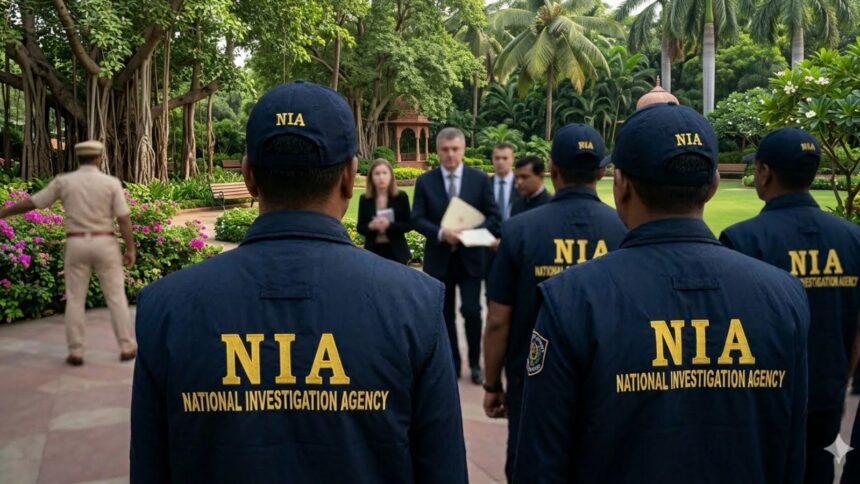
Days after six of its nationals were arrested by the National Investigation Agency (NIA) on charges of conspiring to carry out terrorist activities against India, with the Ministry of External Affairs (MEA), demanding the immediate release of its citizens and access to them.
While an American national was also among those arrested, the US Embassy spokesperson said that while they are aware of the matter, they would not comment on the case for “privacy reasons”.
The NIA has alleged that the group was plotting terror strikes, and their movements had raised alarm over cross-border threats. According to the NIA, the accused were involved in illegally “importing huge consignments of drones from Europe to Myanmar via India” for the use of “ethnic armed groups”. These groups were allegedly also supporting some proscribed “Indian Insurgent Groups by way of supplying weapons and other terrorist hardware and training them”, as per the central agency.
Responding to media queries in this regard, the Press Service of the Ministry of Foreign Affairs of Ukraine said on Monday, “On 13 March 2026, six citizens of Ukraine were detained in the Republic of India. According to preliminary information, the charges concern unauthorised presence in the state of Mizoram, access to which requires a special permit, as well as the alleged illegal crossing of the state border between India and Myanmar. At present, the competent authorities of India are conducting the relevant investigative actions.”
The Ukrainian statement said that “as of now, there are no established facts proving the involvement of the said Ukrainian citizens in unlawful activities on the territory of India or Myanmar” and called the allegations “unfounded”.
“The details of the case are not being disclosed in the interests of the investigation. With the assistance of Ukrainian consular officers of the Embassy of Ukraine in India, the citizens have been provided with legal aid and defence counsel during the court proceedings,” the statement added.
The arrests, a coordinated operation by multiple NIA teams last week, were made under Section 18 of the Unlawful Activities (Prevention) Act (UAPA), along with other relevant sections. An FIR in the case was registered on Friday evening.
The US national was detained by the Bureau of Immigration at airport, while out of the six Ukrainian nationals, three each were detained at airports in and . The suspects were brought to Delhi and produced before the duty magistrate on Saturday, who remanded them in three days’ custody. The suspects were remanded again on Monday until March 27, an extension of 11 days.
As per the Ukraine press office, on March 16, a court hearing took place, which was also attended by representatives of the Embassy of Ukraine. “However, they were not granted the opportunity to communicate directly with the detainees. Following the hearing, the court decided to extend their detention until 27 March 2026,” the statement said.
“Contrary to established international practice, the Embassy of Ukraine in the Republic of India did not receive any official notification from the competent authorities of India regarding the detention of Ukrainian citizens. The Ukrainian side insists on the immediate provision of unimpeded consular access to the detainees,” it added.
As per the statement from Kyiv, the Ambassador of Ukraine to India, Oleksandr Polishchuk held a meeting with MEA Secretary (West) Sibi George, during which he handed over “an official note of protest demanding the immediate release of the Ukrainian citizens and access to them”.
“In addition, the Embassy is maintaining contacts with other competent authorities of India in order to clarify all the circumstances and reasons for the detention,” the embassy added.
Govt sources say, “This is a legal matter and relevant authorities are pursuing it. We are looking into the request for Consular access as per established norms and guidelines.
“The Ukrainian diplomatic mission remains in constant contact with the relatives of the detained Ukrainian citizens and is keeping the situation under special control,” it said. “There are certain restricted-access zones in India for foreign nationals, entry to which is possible only with special permits. At the same time, proper marking of such areas on the ground is often absent, which creates a risk of unintentional violation of the established rules,” it added.