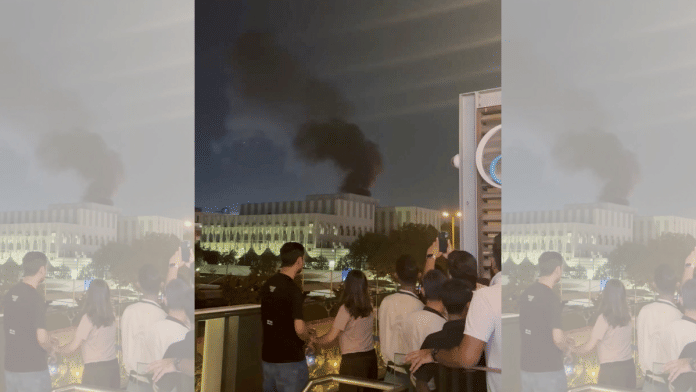
The predicament of ordinary Iranian families residing across the Gulf also warrants consideration. For these individuals, witnessing their country of origin associated with attacks on societies that have provided them with employment, safety, and stability is deeply troubling. Regional stability depends not only on military balances but also on the tacit assurance that neighbours will not use civilian populations as instruments of coercion.
No one disputes Iran’s right to self-defence. International law and common political understanding both recognise this principle when a state is attacked. However, the legitimacy of self-defence depends not only on its invocation but also on its manner of exercise. Self-defence should not serve as an unlimited justification for actions that endanger civilian populations, cities, and infrastructure in neighbouring areas. A state cannot maintain the moral force of its argument if it claims self-defence while causing fear and disruption in the civic life of neighbouring countries.
This distinction is critical. Since the onset of the current US-Israel-Iran confrontation, civilians in Gulf states have repeatedly experienced the threat of missile and drone interceptions. These populations neither initiated the conflict nor bear direct responsibility for the attacks Iran seeks to address, yet they are nonetheless affected by its consequences. This does not constitute a convincing long-term strategy or a morally sustainable doctrine.
A similar short-term logic is evident in the pressure exerted around the Strait of Hormuz. The Strait is not merely a strategic chokepoint; it is a central artery of the global economy, with a significant portion of the world’s oil supply passing through it. Any major disruption in this area has global repercussions, including increased shipping costs, heightened inflationary pressures, market instability, and adverse effects on the daily lives of people far removed from the conflict. What may begin as a tactic for regional leverage rapidly escalates into a source of global economic strain.
This situation highlights a significant ethical contradiction. For a state that draws extensively on the memory and symbolism of Imam Husayn, there should be heightened sensitivity to the moral implications of suffering, restraint, and dignity under pressure. Imam Husayn’s legacy encompasses not only resistance but also principled conduct under duress and moral clarity without sacrificing restraint. A key lesson from his example is that true strength involves not only enduring suffering but also refusing to inflict unjust suffering on others. The denial of water to his family and companions is remembered as an act of cruelty rather than power. In this moral context, any strategy that seeks to demonstrate strength by increasing pressure on a vital resource for millions warrants serious ethical reflection.
The intention is not to draw simplistic historical parallels or to reduce sacred memory to a contemporary slogan. Rather, the aim is to highlight a broader ethical principle: No cause is advanced by expanding the scope of hardship. Imposing suffering on civilian populations, endangering essential economic infrastructure, and compelling neighbouring societies to bear the costs of strategic signalling undermines, rather than strengthens, the moral legitimacy of any struggle.
A more prudent approach for Iran would begin with restraint, both toward civilian sites and infrastructure in neighbouring Gulf countries and in its treatment of the Strait of Hormuz. Such restraint would demonstrate strategic maturity rather than weakness. It would recognise the enduring reality that while war is temporary, geography is permanent. In the contemporary world, no state can afford to disregard its neighbours’ trust, as trade, diplomacy, security, and long-term stability all depend on it.
Iran, therefore, faces a choice that is larger than the immediate conduct of war. It can continue to operate within the narrowing logic of short-term escalation, or it can begin thinking in the longer historical frame that serious statecraft requires. The conflict of the present moment will one day pass. But Iran’s neighbourhood will remain. If trust is spent now, the foundations of any future reconstruction, economic, diplomatic, or political, will be fragile from the outset.
After the war, the true measure of loss is never only physical destruction. It is also the extent to which confidence between societies has survived. Ports can reopen. Cities can rebuild. Shipping lanes can resume operation. But the belief that neighbours can continue to live together safely, that interdependence remains possible, and that one society will not casually expose another to danger in pursuit of its own strategic ends, such confidence takes far longer to restore.
In the days ahead, Iran may discover that its greatest challenge is not solely ending the current conflict, but also restoring the steadily eroding trust—a task that could ultimately define the true success or failure of reconstruction.
(Edited by Theres Sudeep)