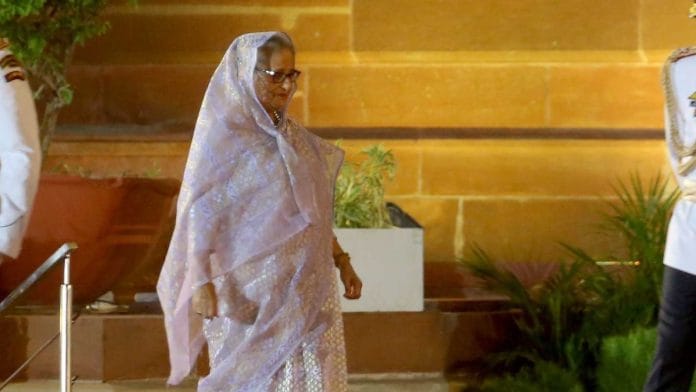
There has been, as well as media speculation, on who Hasina’s political successor would be.
The party should choose a leader from among those in the Awami League who are still inside Bangladesh and can revive the party on the ground by enthusing the cadres at such a difficult time.
After Sheikh Hasina fled to India on 5 August 2024, followed by many of her top ministers and leaders, an unelected interim government took over the reins of the country. The leaders, workers and supporters who stayed back in Bangladesh faced the fury of the mob, as well as the full force of the law.
The arrests continued through the year. And in May 2025, Bangladesh press reported that the Dhaka Metropolitan Police, along with its Detective Branch, over 175 Awami League leaders and activists over the last month, including eight ex-lawmakers from the party.
On 17 November 2025, the three-member International Crimes Tribunal, led by Justice Golam Mortuza Mozumder, sentenced Sheikh Hasina to death for crimes against humanity during the 2024 July uprising. Former home minister Asaduzzaman Khan Kamal was also awarded the death penalty.
On 4 December 2025, a special tribunal an arrest warrant against Hasina’s expatriate son, Sajeeb Wazed Joy, for committing crimes against humanity during the July uprising.
Hasina and her party’s troubles did not stop with this. On 17 December 2025, roughly two months before the national polls, the press reported that Home Affairs Adviser to the interim government, Lt Gen (retd) Jahangir Alam Chowdhury, had police to bring “criminals of the Awami League” under the law even if no cases had been filed against them.
Awami League supporters hoped things would improve under a newly elected government. Even though, in the two weeks since the parliamentary election, locks were at more than a dozen Awami League offices across the country, the new government has not said anything about lifting the ban on the party’s political activities. Nor has any member of the Tarique Rahman government or his party, the Bangladesh Nationalist Party (BNP), said anything about overturning the International Crimes Tribunal verdicts on Awami League leaders.
All that the BNP had done before the polls was pledge to form a ‘Truth and Healing Commission’ to establish a “forward-looking new political culture in opposition to politics driven by vengeance and retribution”.
For now, these are just words, and for all practical purposes, Sheikh Hasina has to continue running her party’s activities from India.
A former Awami League MP who has been staying in New Town, a major suburb in the northwestern fringe of Kolkata, told ThePrint the party’s cadre is totally demotivated.
“We had hoped there would be enough international pressure to allow Awami League to participate in the February polls. That did not happen. And the new government seems to be in no mood to allow Awami League its legitimate space in Bangladesh’s politics,” he said.
The MP, who requested anonymity, said many party workers who had taken refuge in India after the fall of the Hasina government have relocated to the Gulf, Malayasia and Western countries and are trying to settle down with regular jobs or small businesses.
“They still post on social media about their support for Awami League and outrage over all that’s going wrong in Bangladesh, but with no clear directions on how to revive the party on the ground, they are slowly moving away from active politics,” he said.
As far as party workers inside Bangladesh are concerned, they are rudderless without a leader they can turn to inside Bangladesh, the MP said.
“There is growing frustration among Awami League workers, whether in Bangladesh or in exile,” he added.
It would seem there is no immediate hope for the Awami League’s return to Bangladesh’s politics.
After all, the country’s new PM was, in October 2018, held guilty by the Dhaka Speedy Trial Tribunal-1 of a deadly grenade attack targeting Sheikh Hasina and given life imprisonment. Hasina was the country’s PM when the verdict was delivered, and Tarique Rahman was in exile in London. Now that the tables have turned and it is Hasina who faces a death verdict, why would Rahman make any move to rehabilitate Hasina or allow her party any space?
But Bangladesh watchers argue Awami League has come back from bigger setbacks in the past and would do so again. Manash Ghosh, veteran journalist and author of Mujib’s Blunders: The Power and the Plot Behind His Killing, told ThePrint that Awami League’s intrinsic strength is its grassroots leadership and workers who have helped their party fight its way back to the nation’s mainstream politics in the past.
“Having inherited the legacies of the liberation war, Awami League’s relevance to Bangladesh politics is unending,” Ghosh said.
The question now is, who will guide the grassroots workers? On 23 February, The Diplomat noted that since Hasina’s ouster, it is her son Sajeeb Wazed Joy who has been doing most of the talking on behalf of the party and has indicated in several interviews that Hasina may not return to active politics in Bangladesh.
“This has further strengthened the view that he will lead the party. As the Awami League has historically been accustomed to family-centred leadership, many see Joy’s potential leadership as a natural inheritance,” the article said.
But Joy stays in the United States and cannot return to Bangladesh because of the court verdict. Moreover, the larger electorate, outside the Awami League’s immediate supporters, may not be ready to accept Hasina or a member of her family in Bangladesh politics after the events of July 2024.
Saqlain Rizve, Bangladesh correspondent for The Diplomat who has covered the July uprising of 2024, told ThePrint that Bangladeshis who still support Awami League are divided on the issue.
“Some believe the party needs to rebuild itself with a new leadership after the controversies of Hasina’s last term in power. Others remain deeply loyal to the Sheikh family and still see Hasina as the natural leader of the party,” Rizve said.
Rizve told ThePrint that Bangladesh is adjusting to a new government and is focused on whether Tarique Rahman can bring stability. “Any serious discussion on the Sheikh family’s return will have to be conducted at a later date,” he said.
What Awami League needs now is not an answer to who will succeed Hasina or even a debate on whether Hasina should return to Bangladesh, but a new leadership on the ground who can work under Hasina’s guidance but bring a fresh lease of life to the party.
Ironically, the party that it can take a lesson from in this regard is its forever adversary and the current party in power, the BNP.
In the long years the BNP was out of power, its chairman Khaleda Zia was under house arrest and her son Tarique Rahman remained in exile, and Bangladesh saw uninterrupted power of Sheikh Hasina. The BNP’s day-to-day activities, agitations, and political programmes were run by capable leaders like Mirza Fakhrul Islam Alamgir, Amir Khasru Mahmud Choudhury, Salauddin Ahmed and others.
The Awami League needs to find on-ground leadership who can take the reins of the party before it begins to address the bigger questions of Hasina’s return or her successor.
(Edited by Theres Sudeep)