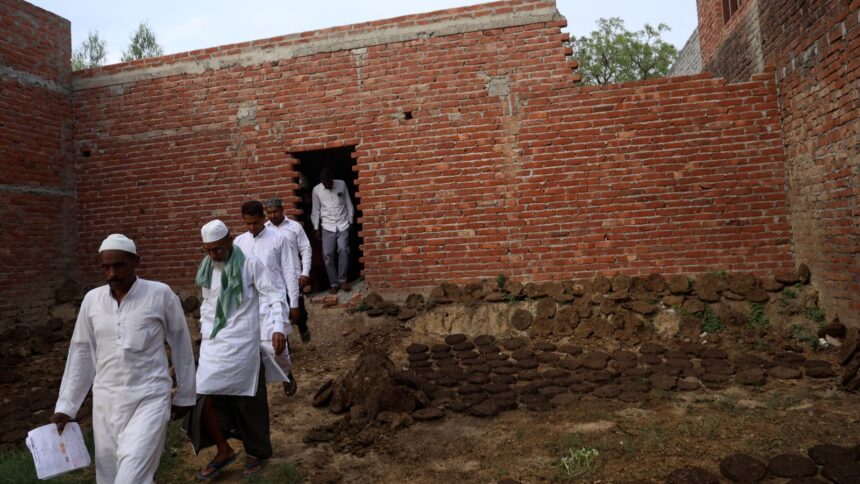
The otherwise peaceful village of Mohammadganj in Bareilly district held its breath Friday as Jummat-ul-Wida prayers, marking the penultimate Friday before Eid-ul-Fitr, were held at a residence.
A policeman stood guard at the entrance to the lane where most Muslims of the village reside, while two more never left the side of Hassen Khan, at whose residence the prayers were being held. Half-a-dozen other police personnel kept a watch around the village of 1,200-odd people.
On March 11, a Division Bench of the Allahabad High Court directed round-the-clock security to Hassen, on a petition by his relative Tarik Khan asking that the Bareilly District Magistrate (DM) and Senior Superintendent of Police (SSP) be told not to interfere in prayers being offered from the private premises of Hassen.
Hassen told the court he was coerced into signing a wrong statement that he was not present and namaz was conducted in his absence at his residence on January 16.
The High Court ordered that two armed guards shall accompany Hassen “wherever he goes”, adding that “any incident of violence that afflicts Hassen Khan’s person or his property shall be prima facie understood to have (occurred) at the instance of the State”. It also directed Bareilly DM Avinash Singh and SSP Anurag Arya to be present at the next hearing on March 23.
In Mohammadganj, where Muslims make up about 40% of the population, most families live off farming, primarily growing wheat and mustard, and rear cattle. A majority of the houses are kuchcha, and open drains criss-cross the village, thick with black sewage. The only school is a government-run primary school.
Tarik says tensions started on December 20 last year, when he began construction of a cattle shed beside his residence, on land owned by him. “We engaged some Hindu labourers from the village… They went to the authorities and the Bisharatganj Police Station complaining that I was constructing a madrasa. Police came and picked me up.”
Standing in the same cattle shed, where a lone cow is chewing cud, Tarik says he was made to give an undertaking on a stamp paper. He shows two copies of the undertaking, dated December 31, 2025, and January 1, 2026, stating in Hindi: “I will not do anything on the constructed premises which may cause any inconvenience to any person from any religion, caste or community or which may create an atmosphere of unrest in the village.”
Tarik undertakes to bear responsibility for any law and order issue due to any activities on the said premises, and says: “I will not have any objections if any proceedings are initiated against me in this regard.”
As per Hassen and Tarik, on January 16, police took action again and picked up around a dozen men, including Tarik, for questioning after they offered namaz on the private premises of Hassen, who is not in the village most of the time as he works as a labourer in Gurgaon.
The men were released after a brief detention, with police saying it had acted given “the sensitivity of the matter” and “apprehending the possibility of tension in the area”.
However, Tarik says, police continued to harass them. “We were repeatedly asked to show whether we had permission to hold prayers. Officials from the Bisharatganj Police Station came practically every day. And since we did not have any such permission, we were told we could not offer namaz on Hassen’s premises.”
Then, on January 27, while hearing another case, the Allahabad High Court upheld the right to conduct prayers by a person, as per their convenience, on their private premises, without any permission from the government.
Tarik says he moved the court in February, seeking that the authorities be restrained from interfering when they offered prayers. While hearing his plea, the High Court initiated contempt proceedings, seeking a response from the Bareilly DM and SSP on why action should not be initiated against them for “flouting” its January verdict that said that no such permission was required for private premises.
SSP Arya did not respond to calls and messages by The , including on whether any action had been initiated against any police personnel.
Says Tarik: “In February, we could offer namaz only on two days – 5th and 14th. After that, we could do so only on Thursday after the (March 11) court order.”
Hassen, who returned to Mohammadganj for Ramzan, and separately moved the High Court on March 11, says he was offering namaz along with his family members at his residence when he was picked up by police “around February 20”.
Hassen also claims that sarpanch Arif Khan, of Bhindora panchayat under which Mohammadganj falls, warned him that if he didn’t tell the authorities that the namaz on January 16 was being offered at his premises without his permission and knowledge, his home would be razed.
While both communities in Mohammadganj say Arif is “hand in glove with the authorities”, the sarpanch refused to comment on the allegations, only saying: “When an undertaking was given by Tarik, it should be followed.”
Shyam Bihari, 32, who lives less than 500 metres from Hassen and Tarik’s homes, claims that as per “a 1995 informal understanding”, neither Hindus can have a temple in the village, nor Muslims a masjid. Tarik broke the pact, he says. “We cannot allow them to pray like this.”
Incidentally, just a few metres from the village government school, there is a devasthan where Hindus gather for worship. The nearest masjid is a couple of kilometres away, in the neighbouring village of Rutia.
Tarik denies the claims, pointing out that they were only gathering to offer prayers at home. “We have always done this. No one objected earlier. But some fringe elements have triggered this discord of late.”
As for the 1995 pact, Tarik and other Muslim residents say they have always adhered to it. “In fact, Hindus have the devasthan as a communal space of worship, and we have none. But we will always hold up our side of the agreement.”
Hassen says that because of the row, he has not gone back for work to Gurgaon, and is losing “Rs 10,000-Rs 15,000 a month”. Tarik adds that as he has not been able to take care of his 20-bigha farm due to frequent rounds of government offices, he is staring at losses.