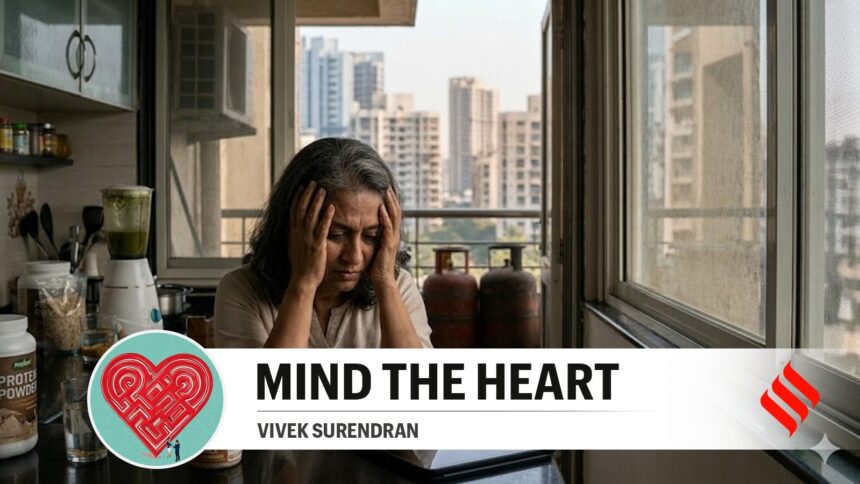
There was a time when calling a woman “strong” meant something uncomplicated. In a man’s world, it meant she fought for her place and earned it. Education, careers, and financial independence — these were victories hard won over . But somewhere along the way, the compliment began to carry a different undertone.
Today, when a woman is described as strong and independent, it often sounds less like admiration and more like expectation. She will manage. She will cope. She will carry whatever life throws at her without seeking or, worse, needing help.
Strength and independence — two powerful, positive words — have begun to function like disclaimers.
Over the past week, I spoke to a few women in my life to understand how this label actually feels from their side. What emerged was not resentment towards these words — far from it. The women I spoke to value them deeply, but what frustrates them is how easily strength becomes a reason for the world around them to step back.
Strength does not cancel vulnerability
One of the first things that comes up when women talk about these tags they are often proud to be associated with is how little room it leaves for vulnerability. Manasi Menon, my fiancée, chose to be a doctor, a profession that demands relentless preparation, commitment and long, tiring working hours. None of that bothers her. What unsettles her is the way that choice gets interpreted.
“Since I chose to be extremely career-oriented, society almost begins to look at you like a villain rather than supporting you,” she told me.
The reasoning behind this reaction is familiar. If ambition was your choice, then you must accept every consequence of it without complaint. “It’s almost like I’m not allowed to have a weak moment or say the workload is too much,” she said.
Strength and vulnerability are not opposites. Resilience is not the absence of difficulty; it is the ability to keep going despite it. Most people expect to be cared for, understood and supported when things feel overwhelming. Women are no different. Why should they be?
“Most women deeply appreciate being taken care of and being understood,” she said.
“Exactly like men do.”
When independence becomes an excuse to withdraw support
Another pattern appears inside households. Women today are encouraged, rightly so, to build careers, earn their own money and live independently. But around domestic and emotional labour have not shifted at the same pace.
Ekta, a communication professional, said, “The problem is that while women are now expected to be independent and taught to be independent, men are not taught the same thing.”
This means the workload rarely gets redistributed. “In a way, women end up doing way more while men are still doing the bare minimum,” she said.
Anyone who has watched how households function will recognise what she means. Managing relationships, remembering family obligations, organising everyday life, the invisible labour of holding a family together still falls largely on women.
“And now it’s like ‘strong, independent bhi bano, aur baaki saara kaam bhi karo (be strong and independent, and do all the work too)’.”
When women speak up about the strain, the first solution that often appears is not sharing the load more evenly. Instead, women are asked to reconsider their independence. “The question becomes ‘kya zaroorat hai tumhe kaam karne ki?’ — what is the need for you to work?” Ekta said.
It sounds practical on the surface, but the implications are deeper. Ekta recalled a period when she was not working full-time. There was no financial pressure, yet she still found herself holding back.
“Personally, I stopped myself from spending freely,” she said. Financial independence is not just about money. It shapes how freely a person moves through the world.
The double burden of modern womanhood
Sanjana, a marketing communication professional, believes the deeper problem lies in how empowerment has unfolded. “I love that women are empowered enough to make their own decisions and earn their own money,” she told me.
“But the expectations inside the house have not changed.” Even in households that see themselves as progressive, responsibilities like hosting guests, planning meals and keeping the household running smoothly still default to women. “So that empowerment itself has come with exhaustion,” she said.
What makes the assumption more frustrating is the idea that careers are optional for women. For many, work is not just about income. “Career doesn’t just give financial security,” Sanjana said.
“For me, it’s also a space where I can be creative, smart and add value.” When I suggested that perhaps it is also about the sense of accomplishment that comes from doing something meaningful for oneself, she immediately agreed. “Exactly. I’m not slogging for others to see it.”
The emotional tax of constant self-sufficiency
The exhaustion of strength often lies not in the work itself but in the expectation of endless composure.
Shivani Bazaz, special correspondent at CNBC-TV18, put this tension into words. She loves the life she has built — the long reporting days, the events, the boardrooms, the adrenaline of journalism. She also has a home and family she is deeply involved in. But the phrase “strong, independent woman” has begun to sound different.
“It doesn’t feel like admiration anymore,” she told me. “It feels like an expectation that you will carry everything without flinching.”
People often assume that modern conveniences — appliances, technology, hired help — have made managing a household easier. But she pointed out that the real work of running a home is not the physical part.
“It’s the mental load of remembering, planning and organising,” she said. And that mental checklist continues long after a 10- or 12-hour workday ends.
“Some days,” she said, “that smile itself is exhausting.”
Strength also requires support
If there is one thing these conversations make clear, it is that women are not looking to step back from independence. That progress is not negotiable anymore. The real issue is that the structures around them have not evolved at the same speed. Women have been asked to change — to work, earn, lead and succeed. But the systems around them, whether families, workplaces or social expectations, have not fully caught up.
That change has to begin with how responsibility is shared. Equality cannot stop at the idea of women working; it has to extend to the everyday mechanics of life at home and at work. Men have to be raised with the same expectation of balance that women have been carrying for decades. that celebrate ambitious women must also build support systems that allow them to sustain those ambitions without burning out.
None of the women I spoke to rejected the idea of strength. They value their independence. They value the ability to make decisions about their lives and pursue work they care about. But women did not fight for independence so that the world could stop caring for them. They fought for it so that care, responsibility and respect could finally be shared.
Strength was never meant to mean standing alone.