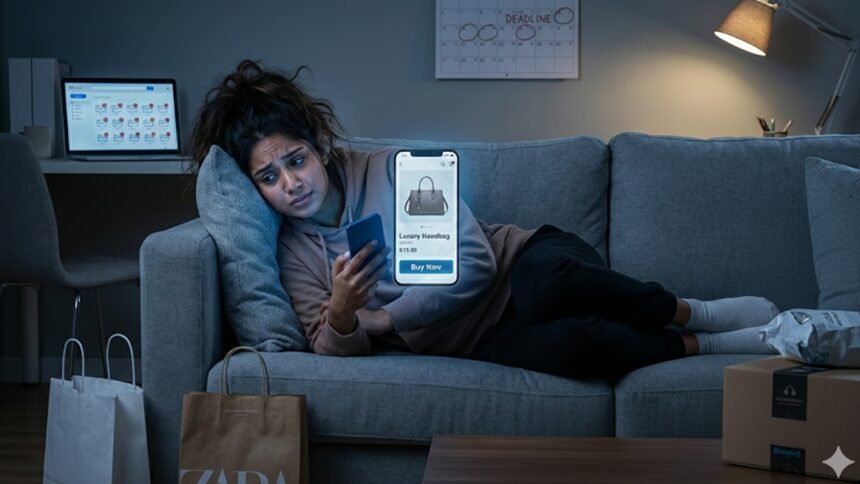
In many cases, financial decisions are driven by one’s income, expenses, savings goals, and long-term planning. But during periods of stress, some individuals may notice a shift in their behaviour. This involves increasing, budgets loosening, and ‘just this once’ expenses becoming more frequent.
Stress can stem from work pressure, health concerns, relationship issues, or broader economic uncertainty. In such moments, spending may offer temporary comfort or distraction. A small purchase can feel like a reward after a difficult day, while larger expenses may be rationalised as necessary self-care. The immediate emotional relief, however, can sometimes lead to longer-term financial strain.
There is also a psychological dimension to consider. When people feel overwhelmed or out of control in one area of life, spending can create a brief sense of autonomy or satisfaction. Easy access to digital payments and one-click shopping has only amplified this behaviour, making stress-driven spending more convenient than ever.
Understanding why stress influences financial choices is essential not just for budgeting but for overall financial well-being. To explore this pattern more deeply, we spoke with a finance expert.
Snehasish Das, financial advisor and analyst at Solvay Bruxelles School of Economics, tells indianexpress.com, “Behavioural economics refers to this phenomenon as ‘compensatory consumption.’ Under significant stress, the brain’s prefrontal cortex, the region responsible for long-term planning and impulse control, is compromised by elevated cortisol levels. Simultaneously, the limbic system, which governs immediate emotional responses, takes dominance.”
When individuals feel a profound loss of control in one area of life, executing a purchase restores a fleeting, powerful sense of autonomy and agency. Furthermore, the act of acquiring a new item triggers a rapid dopamine release, acting as a temporary chemical salve against anxiety. “Consumers logically understand it harms their long-term financial goals, but the neurological demand for acute, immediate emotional relief simply overrides future-oriented rational calculation. They are not buying products; they are purchasing a momentary physiological escape,” notes Das.
“Absolutely,” asserts Das, adding that stress-driven consumption heavily skews toward categories offering the path of least friction and the highest immediate dopamine yield. Food delivery and online shopping are prime targets because they effectively eliminate the ‘pain of paying.’ Digital transactions abstract the concept of money, making a purchase feel significantly less consequential than parting with physical cash.
Das states, “Moreover, these specific categories provide a dual-layered psychological reward: the anticipation of the delivery and the gratification of the unboxing or consuming. Research indicates that low-ticket, high-convenience items, often dubbed the ‘lipstick effect’, surge during because they offer accessible luxury without the guilt of a massive financial commitment. We naturally gravitate toward these micro-indulgences because they offer instant emotional gratification while demanding absolutely zero cognitive effort to acquire.”
“The most effective safeguard against emotional spending is intentionally introducing ‘friction’ into the purchasing process,” reveals the expert. He says that behavioural finance highly recommends the ‘72-hour rule,’ mandating a three-day cooling-off period for any non-essential purchase. This deliberately forces the prefrontal cortex to re-engage, often dissipating the initial emotional urgency.
“Practically, individuals should unlink their credit cards from digital wallets and shopping applications to eliminate one-click purchasing. Additionally, establishing a dedicated, pre-funded ‘splurge account’ can be remarkably effective. By compartmentalising a specific, solely for stress relief, individuals can satisfy the psychological craving for retail therapy without compromising their foundational savings. Ultimately, acknowledging the emotional trigger and redirecting that impulse toward a budgeted, highly controlled outlet protects long-term wealth from short-term emotional turbulence,” concludes Das.
Disclaimer: This article is for informational purposes only and does not constitute financial or investment advice. Individual financial situations vary, and readers are advised to consult a qualified financial planner, advisor, or mental health professional before making financial decisions.