



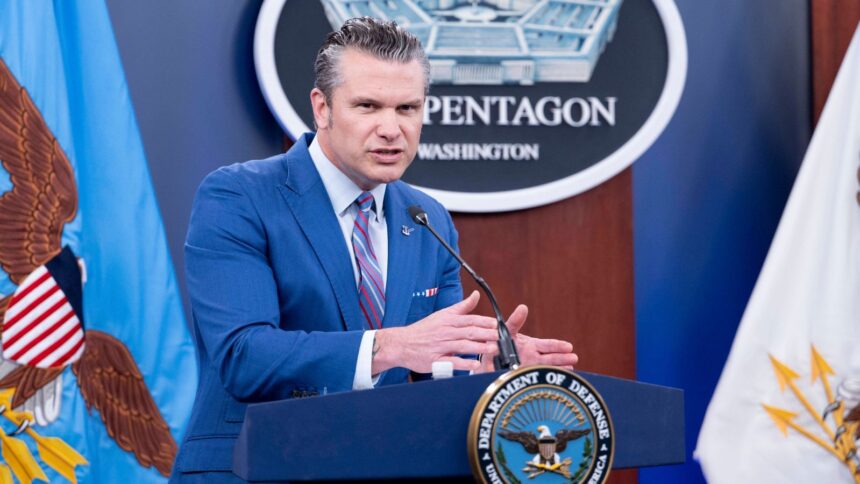
The US will continue advancing its campaign in West Asia and deliver the highest volume of strikes on Iran on Friday, US Defence Secretary Pete Hegseth said at a Pentagon briefing.
Hegseth also said the US and Israel have struck over 15,000 targets in Iran since the conflict began on February 28.
Amid the ongoing global energy crisis and mixed signals from the Trump administration on the status of the conflict, Hegseth reiterated his Department’s strategy to continue bombarding the Islamic Republic.
This came shortly after US President said the US was going to be hitting Iran “very hard over the next week”.
Hegseth said that on Friday, the US will launch “the highest volume of strikes that America has put over the skies of Iran.” This comes a day after the US military said that American forces struck more than 6,000 targets since the operation began. The targets included more than 30 minelaying vessels.
Aside from the attacks on Iran’s military assets, the US and Israel have struck oil reserves, refineries and several other strategic assets belonging to Tehran.
Hegseth told the news briefing that Iran’s newly elected Supreme Leader Mojtaba Khamenei is wounded and likely disfigured. Mojtaba was elected to succeed his father late Supreme Leader Ayatollah Ali Khamenei on March 8.
“We know the new so-called not so supreme leader is wounded and likely disfigured. He put out a statement yesterday. A weak one, actually, but there was no voice and there was no video. It was a written statement,” Hegseth said.
The mid-level cleric, known for his close association with the Islamic Revolutionary Guard Corps, was reportedly wounded in the initial US-Israeli coordinated strikes on February 28 that killed his father. He has not made a public appearance since the conflict began.
Hegseth said Iran’s missile volume is down 90 per cent and its one-way attack drones reduced by 95%, adding that very soon all of its defence companies “will be destroyed.”
The US and Israel have been carrying out strikes against Iran’s ballistic missile and drone infrastructure in stages. Having targeted Tehran’s launchers and warheads, they are now reportedly planning to hit their supply chains.
Hegseth said Iranian leadership has gone underground, adding that they are moving to bunkers and civilian areas.
The US and Israel have pursued a strategy of skimming off Tehran’s top leadership in a bid to force regime change by boosting confidence among dissidents.
In the first half of January, the Islamic Republic witnessed the largest anti-regime uprising since its founding. It was followed by a brutal crackdown, with reports indicating approximately 30,000 fatalities.
Hegseth said US President Donald Trump “holds the cards” and will decide when to strike. Earlier on Monday, Trump said that the “war is very complete,” but days later, Mojtaba made his first public statement, vowing to keep fighting and threatening to open “other fronts” in the war.
Since the war began, Iran has pursued a strategy of choking trade through the Strait of Hormuz – the transit for more than a fifth of the world’s oil and gas supplies – triggering an energy crisis.
On Friday, the Associated Press reported that at least 19 commercial vessels were attacked or damaged in the Persian Gulf and surrounding areas since the start of the conflict. Tehran has been targeting fuel tankers and related assets in the region using drones and ballistic missiles to pressure US regional allies to persuade Washington to end its assault.
To combat soaring energy prices and shortages, the International Energy Agency (IEA) announced that it would release 400 million barrels of oil. The US also announced a 30-day sanctions waiver for Russian crude, providing relief to Moscow amid the ongoing war in Ukraine.

