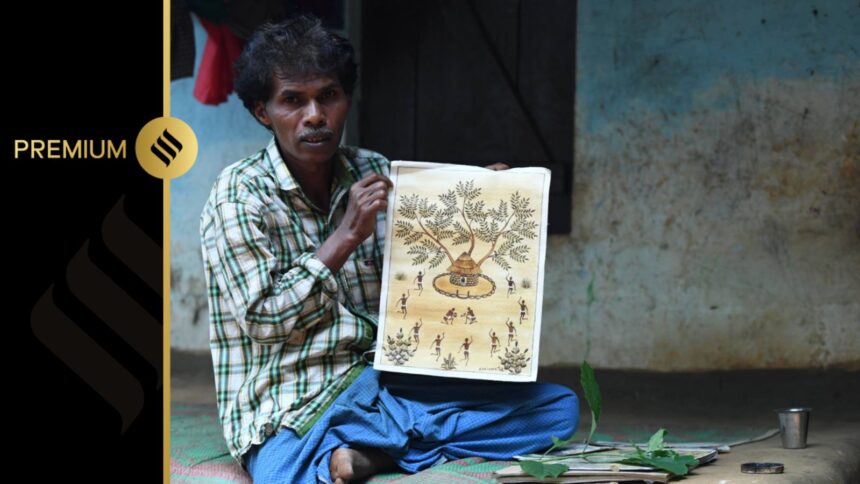
For members of the Alu Kurumba community in the Nilgiris, the Centre’s announcement of a Padma Shri earlier this year was both surreal and heartbreaking. The award went to Krishna Raghavan, known by his pen name Kitna. But it came after his death.
Born in the Vellarikombai settlement in Kotagiri, , Krishna belonged to the Alu Kurumba tribal community, a subgroup of the Kurumba. The Kurumbas are classified as a Particularly Vulnerable Tribal Group (PVTG) in India. According to the Indian government, a tribal community can be designated as a PVTG if it is socially and economically backward, has a stagnant population, and has low literacy levels. The Nilgiris district is home to all six PVTG communities identified in Tamil Nadu.
While the posthumous honour cast a spotlight on Krishna’s work, it also revived a troubling question: who will carry forward his legacy?
Kurumba is a prehistoric art form, estimated to be over 3000 years old. According to reports, the earliest documented evidence of Kurumba paintings on dwelling structures in the Nilgiris can be traced to the period of 1871-1872.
The art was traditionally drawn on rocks and in caves across the high hills of the Nilgiris.
Today, fewer than 10 indigenous practitioners remain. Among them, only three know how to extract the natural colours used in the paintings that make the artwork last longer.
Tribal leaders and activists fear that without immediate support, the art form could disappear. They are urging the state government to recognise the artists who still practise it and to create a visual anthropological record of Krishna’s works as evidence of the Alu Kurumbas’ way of life.
Krishna was born in Vellarikombai and grew up learning traditional knowledge from his maternal grandfather, Kithari. Along with lessons on cultivating millets, collecting honey and preserving forest produce, Kithari also introduced him to drawing on rocks and rock beds.
Every year, Kithari took Krishna to the Ezhuthuparai cave, where community elders had for centuries drawn paintings on rock surfaces. At the age of six, Krishna began learning these patterns.
What began as a hobby gradually evolved. Krishna started replicating the drawings on cloth, later moving to canvas and paper. Over time, exposure to other indigenous art forms across the country helped shape his craft. Scholars today refer to his work as the “Krishna school” of Kurumba art.
His paintings depicted the life of the Alu Kurumba community, once hunter-gatherers and honey collectors living primarily in the Coonoor and Kotagiri regions of the Nilgiris. His art became a visual narrative of the community’s culture.
KT Gandhirajan, a project officer at the Tamil Virtual Academy, said Krishna played a crucial role in reviving an art form that was once found in caves and on the walls of Kurumba habitats in the Nilgiris.
“He (Krishna) met several artists and trained at a few institutes to shape the art form and convert it into a conventional one. People often say they find similarities between Warli art and Kurumba art. But the geometric art forms of Warli depict the celebrations of tribals from Maharashtra. However, Kurumba art depicts the life of Alu Kurumba, their marriage rituals, menarche ceremonies, funeral rituals, and ancestral worship,” he said.
The colours themselves come from the forest. The essence from the Vengai tree trunk is used to produce yellow, brown and purple shades, Pachaikeeda leaves are crushed to provide green pigment, red sand gives earthy tones, and the Karimaram tree is used to produce black, explains Krishna’s wife Sushila.
Krishna’s paintings focused on the community’s relationship with the flora and fauna of the Nilgiris, their cultivation practices, and methods of rock honey hunting. Krishna’s works were the extension of an early Kurumba art form. His artwork is categorised into three themes — social life, ritual life, and daily life — under which he produced hundreds of paintings.
“He was an artist. Artists who follow his methods are now just craftsmen,” Sushila said.
Krishna’s works travelled far beyond the Nilgiris. According to Kannan Ramaiah, co-founder of the Heritage Foundation, a non-profit organisation located in Kotagiri, Nilgiris, Krishna’s paintings now hang in the homes of foreign visitors to the region, in the houses of Tamil cinema personalities such as Pa Ranjith and Mari Selvaraj, and in art galleries across the country.
Yet, despite the grand reach, his family lived in poverty. “During his last days, he was not able to make money to repair his house, which was damaged by a wild elephant,” Kannan said.
Sushila recalled that Krishna often painted for free and charged between Rs 50 and Rs 1,000 for a painting.
“People never consider the time, effort and talent that go beyond such works,” Ramaiah added.
After Krishna’s sudden death, the family’s financial situation worsened. A single mother with four children, Sushila eventually moved from Vellarikombai to Mettupalayam in Coimbatore district to live with her parents.
“In Vellarikombai, I was working as a farm labourer in coffee estates and pepper farms. After his demise, it had become very tough for me to go to work and return home to a wildlife-bearing area to take care of my four children,” she said.
According to Sushila, the settlement does not have proper roads or transportation. “We need to walk three kilometres to get any sort of transportation facility. The presence of wild elephants was one of the reasons for me to consider relocating,” she said.
In Mettupalayam, Sushila continued to work as a farm labourer for a daily wage of Rs 300, barely enough to cover monthly expenses. One of her daughters, Vasuki, dropped out of college last year.
Even as Krishna’s work gained recognition, Kurumba art itself remained fragile.
Only a few community members, including Bala Subramanian, Ganeshan, Bharath, Adi Bellan, Dharshini, Sornavalli and Sivakami, currently practise the art. They were once Krishna’s students.
With limited recognition and income, activists fear younger members of the community may not consider pursuing the art form.
Krishna himself had once expressed the wish to obtain a Geographical Indication (GI) tag for Kurumba art to prevent exploitation by outsiders. Yet he also taught school students and non-tribal learners.
“Krishna wanted to protect the art form, but he never stopped anyone from learning it,” Ramaiah said. “He wanted the art to continue as a legacy.”
Krishna had once expressed his disappointment that the state government had hardly recognised his contributions to the art and urged the government to support artists like him.
Following the Padma Shri announcement, however, the state government initiated several steps to support his family. In February, it announced a permanent job for Sushila as a gardener at the Eklavya Model Residential School in Ooty with a monthly salary of Rs 32,000.
The Tamil Nadu Adi Dravidar and Tribal Welfare Department also organised an event called Ajil Pottu – Alu Kurumbar Kalaiyum Kalaignanum on February 21. At the event, community members from the Nilgiris and researchers gathered to pay tribute to Krishna and stressed the need to recognise artists while they are still alive.
Tribal rights activist Odiyan Lakshmanasamy said the state government should take steps to ensure the next generation of Alu Kurumbas continues the tradition.
“The state government should not wait for the Union government’s recognition to honour our artists. The state should reward existing artists to keep them practising their art,” he said.
He also suggested introducing certified courses for Alu Kurumba students who want to learn about their art, along with a stipend. “It will ensure both students and their teachers have money and time to learn their own art form,” he said.
Gandhirajan concurs. “The uniqueness of his (Krishna’s) paintings is that they were decorative yet thematic. His research into natural dyeing and his introduction of new methods to shape the art form deserve the same treatment that has been given to classical music and dance forms in Tamil Nadu.”
Gandhirajan also called for Krishna’s works to be collected to produce a visual anthropological record. “The record would act as an introduction for those who want to learn more about Alu Kurumbas. Through his art forms, the gap between the mainstream and tribes would be reduced.”
Krishna is survived by his wife Sushila and their four children — Vasuki, Rahul, Deepa and Keerthika. “Krishna wanted to protect the art form, but he never stopped anyone from learning the art. He wanted the art form to continue as a legacy,” Sushila said.
“He dedicated his entire life to art. Even on the days when we starved, he was not ready to give up his art,” says Sushila, adding that the award and recognition came too late.