Despite the incessant bombing of Iranian urban centres and the killing of their former Supreme Leader, Ayatollah Ali Khamenei, along with other luminaries of the power structure, the regime has survived. Tehran’s counter-strategy was to increase the heat among its neighbours—mostly US allies—to realise the consequences of a conflict aimed at ‘eliminating’ Iran. Tehran’s military prowess may not be comparable to that of the US, but the flames of war could spread to its neighbours’ soil and consume them.
Iran, interestingly, has not even started to deploy its ideological arsenal and motivate the Shia population that lives around the region. In any case, a collapsed and broken Iran does not bode well for the entire Persian Gulf region. It is not just the Shia population around the region but also the varied militant groups that are bound to get energised and return to life in case Washington completely overpowers Iran.
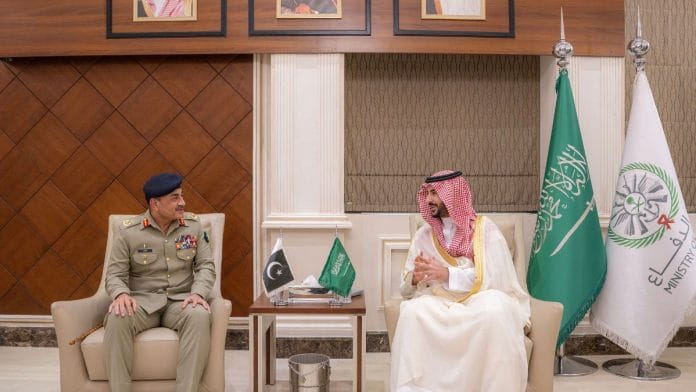
It’s this heat that seems to be bothering Saudi Arabia, which has sought help from its South Asian ally. In fact, the Pakistan-Saudi Arabia strategic signed in September last year was always aimed at threats emanating from Riyadh’s immediate neighbourhood. In hindsight, it seems that the agreement, which was penned immediately after an Israeli attack on Qatar, reflected a sense in Riyadh that the conflict would expand and might create tensions that needed to be addressed through strengthening security.
In September 2025, Saudi Arabia was not just concerned about the Yemeni Houthis but about Iran as well. Notably, they were more concerned about Tehran than Tel Aviv. The more recent discussions in Riyadh are not about deploying Pakistan’s armed forces, but using its military and diplomatic capacity to influence Tehran over the futility of expanding the conflict to Saudi territory, which is exactly what Islamabad seems to be doing.
Given the drone and ballistic missile attacks by Iran on Saudi Arabia, Pakistan has been at the forefront, communicating Riyadh’s displeasure to Tehran. It is reminding the Iranian establishment of the Islamabad-Riyadh defence agreement, which may force it to defend the Kingdom of Saudi Arabia. Additionally, sources claimed that Islamabad has been active to minimise the threat to its West Asian ally by contacting Iran’s revolutionary guards, the Islamic Revolutionary Guard Corps (IRGC) and Saudi intelligence.
Such diplomatic arm-twisting or vigorous contacts do not necessarily mean that Islamabad is about to jump into the conflict actively. In fact, just a few days ago, as my sources claimed, the Inter-Services Public Relations (ISPR) chief called several journalists to discuss the military’s position. These journalists were informed that, although Pakistan was ready to stand by Riyadh, a lead would have to be taken by the Saudi military, for which there was no indication yet.
All that Islamabad is expected to do at the moment is to use diplomatic means in bringing down the temperature, a goal that it seems to have achieved, as there are fewer attacks on Saudi Arabia than Bahrain or other Gulf states. But it is equally doubtful if Pakistan’s military would ever want to move its boots on the ground in areas bordering Iran, which is not where Pakistan is prepared to go.
As it is, there is in Gilgit-Baltistan, where there is a concentration of the Shia population, resulting in Pakistan Army deployment and curfew being imposed in Skardu, Gilgit and Shigar. After Iran, Pakistan has the highest concentration of Shias.
Of course, Pakistan has had tension and resultant military scuffles with Iran in the past. In January 2024, both neighbours at each other on the suspicion of militant hideouts. But the conflict was quickly managed and toned down. Pakistan has also suffered from decades of sectarian strife, which analysts claimed to be a Saudi Arabia-Iran ideological cold war that ended in the late 2000s.
Islamabad, obviously, would not want to see a repetition of the events. Understandably, it has also not put its front foot in support of any American manoeuvre against Iran that would use its territory.
It’s worth mentioning that both the Pakistani state and society have an interesting perception of, and relationship with, Iran. Though a Sunni state that experienced internal pressure in the form of heightened sectarian tension after Iran’s 1979 Islamic revolution, it was one of the post-Zia-ul-Haq army chiefs who reached out to Iran, offering nuclear technology.
Another source also said that it was one of the prominent icons of a political family that established contact with Iran for the purpose. As far as the society is concerned, despite Pakistan being predominantly Sunni, there is a general sympathy for the neighbouring state and an anxiety regarding what is being done to it by the US. Not to forget the larger apprehension that if Iran can be eliminated, then Israel and the US may Pakistan as well.
Nonetheless, Islamabad may also look at the Saudi-Iranian tension as an opportunity not just to play a role on Riyadh’s behalf but also to milk the moment to its financial advantage. Recently, Islamabad requested the Saudis for financial help, including the conversion of Saudi Arabia’s existing $5 billion deposited with Pakistan’s State Bank from a short-term existing facility that needs to be renewed every year into 10 years long commitment.
This is what it needs for its negotiations with the International Monetary Fund (IMF) to get the Extended Fund Facility. In addition, Islamabad has asked for an of the deferred oil payment from $1.2 billion to $5 billion and an increase in Pakistani remittances from Saudi Arabia to $10 billion, which means an increase in work visas for Pakistanis.
Apparently, Riyadh has not made any commitment to increase the visas and wants to decide after the war is over.
But asking Riyadh for money in exchange for its security cannot just be looked at as some barter deal. It seems that the defence agreement that the two countries signed already commits Saudi Arabia to helping its South Asian ally with its economic development. Surely, the Saudi kingdom is not about to pour money into Pakistan, but sustaining its partner may be necessary to get it to perform if any military help is needed at all.
Perhaps, beefing up air defence is a possibility that would give confidence to Riyadh. The security of Saudi Arabia is something that the Pakistani armed forces have long committed to, even before the September 2025 agreement.
(Edited by Saptak Datta)