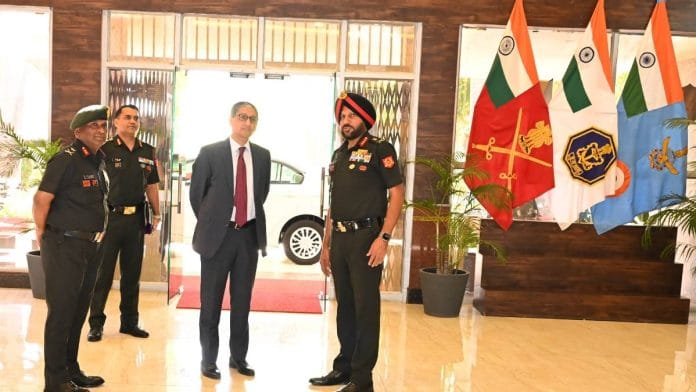
Delighted to be , welcomed by Commandant Lt. Gen. Harjeet Singh Sahi.
Learnt of (🇮🇳 Army War College)’s long legacy.
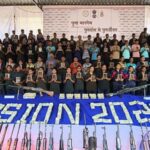
With 180 sr. military officers of Higher Command Course from 🇮🇳Tri Forces, shared perspectives on the state of | ties, ways to…
— Riaz Hamidullah (@hamidullah_riaz)
Defence sources said that visits by diplomats are a regular feature and that the previous Bangladesh High Commissioner had also visited the Army War College in 2024.
Sources said some diplomats deliver talk physically while some address through video-conferencing due to time constraints. “We have global footprint in terms of foreign officers attending Junior Command, Senior Command and Information Warfare Course,” a source explained.
Hamidullah, who was appointed Dhaka’s High Commissioner to India by the previous interim government led by Chief Adviser Muhammad Yunus, has repeatedly sought to highlight the joint military and cultural history of both nations, even as political ties soured since former prime minister Sheikh Hasina was ousted from power in August 2024.
In November 2025, Bangladesh Armed Forces Day held by the High Commission in the national capital, Hamidullah paid homage to the 1,668 Indian soldiers who lost their lives during the 1971 Liberation War. India’s Director General of Military Operations, Lt-Gen Manish Luthra, was present at the November commemoration.
The Bangladesh envoy’s visit to the Army War College comes barely a week after Dhaka’s Director General of Forces Intelligence, Maj. Gen. Mohammad Kaiser Rashid Chowdhury, visited New Delhi and held meetings with Parag Jain, Research and Analysis Wing (R&AW) chief, and his Indian counterpart Lt-Gen R.S. Raman, as by ThePrint.
The private dinner between Jain and Chowdhury on 2 March was a step taken by New Delhi and Dhaka to open communication channels that had been frozen since Hasina’s ouster, where an understanding was reached that the respective territories of India and Bangladesh would not be allowed to be used by actors that have “inimical interests”.
Chowdhury also held meetings with India’s National Security Adviser Ajit Doval and attended an intelligence roundtable, organised annually by India on the eve of the Raisina Dialogue.
India and Bangladesh are looking at ways to mend relations and normalise ties, following Tarique Rahman’s assumption of power in Dhaka on 17 February. Chowdhury’s visit to India was within a few weeks of Rahman’s victory, a signal of intent by both countries to move forward from the Yunus-era slump in relations.
A number of irritants remain, including Hasina’s continued stay in India. The former Bangladesh PM was sentenced to death by the International Crimes Tribunal Bangladesh (ICT-B) last year for her government’s actions in trying to put down a student-led demonstration between June and August 2024.
The two sides also imposed a number of economic restrictions on one another last year, including enhanced customs checks, and cancellation of transshipment access. However, India Tuesday signalled that despite the ongoing conflict in West Asia, and the fears of supply challenges of crude oil, it will continue to supply diesel to Bangladesh on a “commercial basis” from the Numaligarh Refinery, defence sources said.
According to a source, the fuel will continue to be routed through the “India-Bangladesh Friendship Pipeline”. The Bangladesh administration had said that roughly 5,000 tonnes of diesel is expected to be supplied by India.
The two countries are looking at other means to tamp down the differences as a number of diplomatic challenges remain, including the renewal of the Ganges Water Treaty, that is set to expire in December 2026.
(Edited by Nida Fatima Siddiqui)