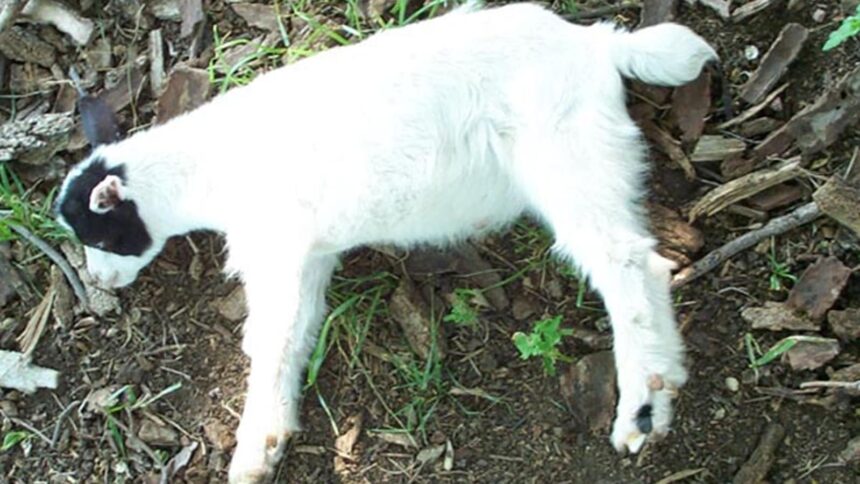
Fainting goats, also known as Tennessee fainting goats or myotonic goats, have fascinated people for centuries with their peculiar reaction to sudden stimuli: they appear to “faint.” But unlike the fainting we typically understand in humans, these goats don’t lose consciousness. Instead, their stiffening response is caused by a unique genetic condition that temporarily locks their muscles, making them appear to freeze or fall over.
The fainting phenomenon in is caused by a hereditary condition called myotonia congenita. This genetic mutation affects the chloride channels in muscle cells, impairing the ability of muscle fibres to relax quickly after contraction. When startled, excited, or sometimes even during vigorous movement, their muscles stiffen involuntarily for about 10 to 20 seconds.
According to the Natural History Museum of the UK, the goats do not lose consciousness during these episodes. Instead, the stiffness in their legs causes them to topple over, often falling sideways or backwards. After the episode, the goats quickly recover and resume normal activity.
In 1930, geneticist Jay L Lush wrote in the Journal of Heredity, “While in this condition they can be pushed or turned over as if they were carved out of a single piece of wood.”
The fainting goat breed originated in the 1880s in Tennessee, USA. Farmers initially bred these goats for meat and as a curiosity. The genetic mutation was traced to a single founding animal, and since then, it has been perpetuated by selective breeding.
Studies published in veterinary journals confirm the biological basis of myotonia congenita in these goats. Unlike conditions causing fainting or seizures in other animals, fainting goats remain alert and conscious throughout their episodes, making the phenomenon unique.
While fainting may seem like a disability, the myotonic condition actually gives these goats certain advantages. Their stiffened muscles can help them avoid predators by startling predators with sudden movements. Additionally, the condition does not significantly impact their overall health or longevity.
From an agricultural standpoint, fainting goats have also become popular as pets and for small-scale farming, partly because of their unusual behaviour and ease of management.