As India landed in Ahmedabad, one step closer to becoming the first team to successfully defend the T20 World Cup crown, they still carry the favourites tag. With New Zealand awaiting them in Sunday’s final, Suryakumar Yadav’s side appears to be peaking at the right time after stuttering at the start. Game by game, each concern has been addressed. This reinforces why they’re the No. 1 team in the format.
But one hole remains.
The form of ordinarily the world’s best batsman in the format — — and best bowler — Varun Chakaravarthy — remains a concern. While other batsmen have compensated for Abhishek’s lack of runs, the bowling department hasn’t had the same cover. In the matches Varun has struggled, India have looked flat in the middle overs. It’s a hole they’d rather not have heading into a final.
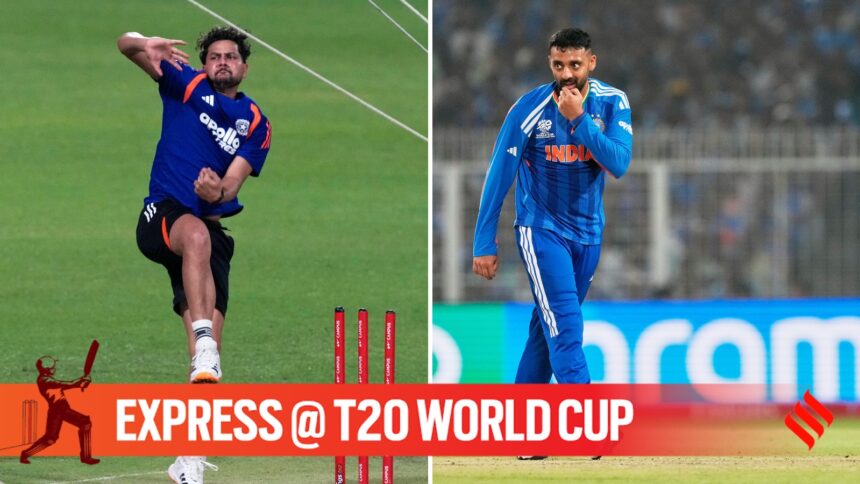
With 13 wickets, Varun is tied for most in the tournament. But through the Super 8 stage, he’s looked far from the menacing bowler he was in the lead-up. His performance against England — 64 runs in four overs — means will be part of India’s discussions going into the final, The understands. With his ability to spin the ball both ways and enough variations up his sleeve, Kuldeep offers another X-factor.
The numbers tell the story. Eight of Varun’s worst performances — conceding 35 runs or more — have come since the beginning of the South Africa series at home. The 64 against England was his worst return. In the Super 8 stage, he’s averaged 46.5 and gone at 11.62 runs per over with four wickets.
***
On a night when the Wankhede groundstaff rolled out a flat deck, Varun bore the brunt. Without enough turn, England’s batsmen backed themselves to hit across the line and straight. Having started by conceding three sixes, he bounced back in the same over to remove Jos Buttler. But as Jacob Bethell and Will Jacks attacked with full intent, he was repeatedly guilty of delivering in the hitting arc.
For a spinner who always seemed ahead of batsmen, Varun has shown signs of struggle when hit on the full. Sanju Samson pleaded to him in Tamil: “Machi… time eduthu podu (take time and bowl).” Varun seldom followed it through the night. Advice is easy to give. Harder to follow when the ball keeps disappearing into the stands. Where once he set batsmen up with impeccable control of line and length, he bowled short and wide — even resorting to bowling too quick. To compensate for the lack of turn on batting-friendly pitches, as his mentor AC Pratheepan had revealed to this daily, Varun had used angles. That had very little effect.
“I still don’t think Varun bowled that badly,” former India spinner R Ashwin said on his YouTube channel. “But I don’t understand why he continues bowling around the stumps to left-handers. When he’s bowling round the stumps, he’s not able to bowl tight lines. From round the wicket, they say it keeps stumps in play, LBW in play, you can get a wicket every ball. But sometimes in T20 cricket, when you know the conditions are against you and the batsmen are striking well, you need to get the batter off strike. You need to bowl defensively. You need to know when to attack and when to defend.”
With Ahmedabad set to roll out another batting-friendly surface, India are looking to cover all their bases against New Zealand. Although they’ve been patient with Varun throughout, should conditions demand, they’re weighing the option of bringing in Kuldeep. Before the tournament, India decided only one of the two would feature in the XI — a balance call — and Kuldeep got the nod only for the Pakistan game in spin-friendly Colombo. Against New Zealand, they could fancy him again. He poses a serious threat in the middle overs, and except for Daryl Mitchell, few Kiwi batsmen use their feet against spinners. Against Kuldeep, getting away is hard.
Having watched opposition treat Varun like a medium-pacer, this New Zealand outfit — smart with planning and tactics — could employ a similar strategy. Their batsmen’s long reach only adds to the Kiwis’ credentials to do so. The hole India would rather not have may yet force their hand.