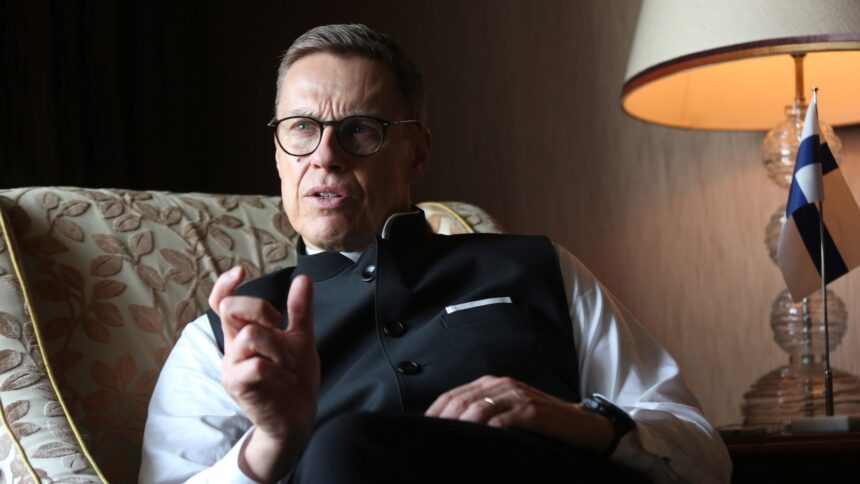
President of Finland Alexander Stubb, , met Prime Minister Narendra Modi Thursday and the two leaders decided to upgrade ties to strategic partnership on digitalisation and sustainability.
In an interview with The on the sidelines of the Raisina Dialogue Friday, Stubb shared his views on India’s growth, its peacemaking abilities, bilateral areas of cooperation, his assessment of US President , the ongoing conflict in the Middle East and Ukraine, and his advice to the Indian youth.
Yes, I’ve been in office for two years. And this my first visit to India. But I’ve been to India a few times before, and the last time was in 2013 as Minister of Trade.
On a general level, my key takeaway is that India is thriving. You have to see it to believe it when you come to a country that has a 7% growth rate that has 250 million people that have been lifted from poverty in the past 10 years. When you see the big infrastructure projects, when you see projects that help in the day-to-day life of Indians, there is a sense of optimism here, which you rarely see nowadays, especially in the Global West. India is one of the few truly thriving economies right now. So my sort of big takeaway has been extremely positive, and of course, I see it with my own eyes. The difference from 2013 to 2026 is startling.
I think the key difference is that when you look at the streets and the infrastructure, you look at the roads, it could be that my police escort is only taken to good places, but New is a big place, so I’ve been very impressed with that.
Then, on a second level, my key takeaway has been the extremely interesting discussions on geopolitics, a changing world order, and India’s place in it. And then a realisation how close Europe and India are right now, and how important is that we have that as a key relationship thriving going forward. Because when the world is in turmoil, there are things such as values that bind us. So I’m really pleased with what I have seen and felt, and also the warm hospitality and obviously Prime Minister Modi has been elected three times, which is quite unusual in today’s democracies. And it’s been a great pleasure to engage in conversation with him and with Foreign Minister Jaishankar, with the President and the Vice President.
Well, I think first of all, the big frame is, of course, the European Union and the Free Trade Agreement, because we are part of the EU, and the EU has exclusive competence on trade. So this kind of gives us more instruments, and it takes down trade barriers. But I define the following key areas. All of them are actually linked to technology, but the first one would be networks. Nokia is still one of the biggest network companies in the world. Roughly half of the 5G here in India is by Nokia.
Secondly, quantum, because quantum is basically the infrastructure and enabler for Artificial Intelligence. And I know that India is now very focused on AI, not only because of the AI summit, but because of your vibrant engineering and tech sector. We have the top two of the top five quantum companies in the world… and if we start achieving generative AI within three to five years from now, we’re going to need infrastructure for it. And I think this is one area where we can cooperate.
And third where I think we can cooperate is our satellites, because I think our thinking on data is very similar. In other words, we feel it’s important to protect the individual and privacy and satellites are going to be future data centres.
This has been a strategic failure for Russia on three accounts. First, they wanted to make Ukraine Russian. It became European. They wanted to prevent NATO from enlarging. They ended up with Finland and Sweden, which would have not joined, had Russia not attacked Ukraine. And then, they wanted to keep European defence expenditure and therefore capabilities down. And now we are going possibly north of 5% of GDP on defence expenditure. So, Russia has kind of revived Europe’s defence composure.
Then, secondly, in my mind, it has been a military failure for Russia. In World War II, they advanced 1,600 km in four years. Now they have advanced 60 km in four years, and the human cost is mind boggling in the sense that in the last three months, over 90,000 dead Russian soldiers…
Finally, it’s been an economic failure for Russia in the sense that they have now run out of reserves. They have zero growth. They have 16% interest rates, double digit inflation, and a banking sector which is in a potential crisis. So you know, where are we after four years after the war? We’re nowhere, and we should acknowledge that.
Now, does this mean that we should give up all hope and say that there is no peace agreement in sight? Now, I think we should work towards peace… the work that the Russians, the Ukrainians and the Americans are doing has progressed… So we’re making progress, but we’re not there yet. The problem is that Russia is not going to win this war, but I don’t see them ending it either, and that’s the dilemma that we have.
Well, I mean, the first observation is to say that diplomacy always happens based on two pillars. One is State-to-State relations. So that’s about history, values, interests, power, geography, culture and alliances. And there we are very close with the United States. And the second one is the personal relationship, which people quite often forget is actually one of the most important parts that leaders get along with. I mean, there’s a reason why I want to visit India, and that is that I would like to forge a relationship with Prime Minister Modi, because I think he’s a great leader, and I’ve done the same thing, obviously with Trump, and golf was a good connector on that.
But I have no illusions about my role with the President (Trump). The President, as we know, is very much his own man. He decides so on Ukraine. If I’m able to throw out 10 ideas and plant one of them, I think it’s been a success.
President Trump has his own way of negotiating and trying to achieve results, and I hope what he’s doing works, and I think the US sees its role more as a mediator than siding with one party or another. So then our job, as strong supporters of Ukraine, is to try to support the process.
Yes, we did discuss that with Prime Minister Modi and also with Foreign Minister Jaishankar. My worry, of course, is one of escalation. We’re now almost into seven days of the war, at least six days of the war so far, and we have seen it expand at the pace which we haven’t seen wars expand of late.
So we have 11 countries that have been hit by missiles. I think the counter strike by Iran was a strategic mistake, because they are now isolating themselves in the region. When you start bombing not only the military bases of the United States or of Israel, but specifically civilian infrastructure, like hotels, harbours, airports, energy, then you end up turning sympathies around. So I think that Iran is right now between a rock and a hard place. We would like them to de-escalate.
I’ve had the chance to speak with both President Muhammad bin Zayed of the UAE and the Emir of Qatar to express my strong support for their endeavours to defend their own countries. But right now, I see a spiral of escalation which is not going to end anytime soon, which is unfortunate. I don’t think anyone knows the end game of where this is going to go. It is self-evident that the Americans and the Israelis are trying to destroy the nuclear capabilities of Iran and their missile capabilities. They also want to weaken the proxies of Iran like Hezbollah, Hamas and Houthis, and then I would assume at the end of the day, they want regime change. Whether they succeed or not, I don’t know.
It is quite self-evident that the US is now acting outside the traditional framework of international law. At the same time, there is always a question of ends and means, and we don’t know, but what I think makes these strikes different from Afghanistan, Iran and Libya, which are the latest examples, is that this time around the US has not sought justification from the UN, it has not consulted its allies. And probably the narrative of justification is a little bit different from what we saw, for instance, in Iraq, or actually in Afghanistan. So it is a different form of action, that’s for sure. I don’t deny that.
A peacemaker…I’ve always seen India as a nation of peace. India is one of the few countries that can pretty much talk to everyone, in the Russia -Ukraine case, to both Ukraine and to Russia. And then, of course, in Iran, Israel, the US context, it does have a lot of voice. But, I come from a small country, so I’m not going to give advice on what India should do.
Well, if I could give one piece of advice to Indian youth, is what I call one plus one plus one, which means that for every day, exercise for one hour, because that gives you two more hours of energy for every day, read a book for one hour, because that quietens the mind and gets you into a zen mode. And then the third one is to be on social media for only one hour a day. Trust me, it’ll make you happy. And I come from the happiest country in the world.