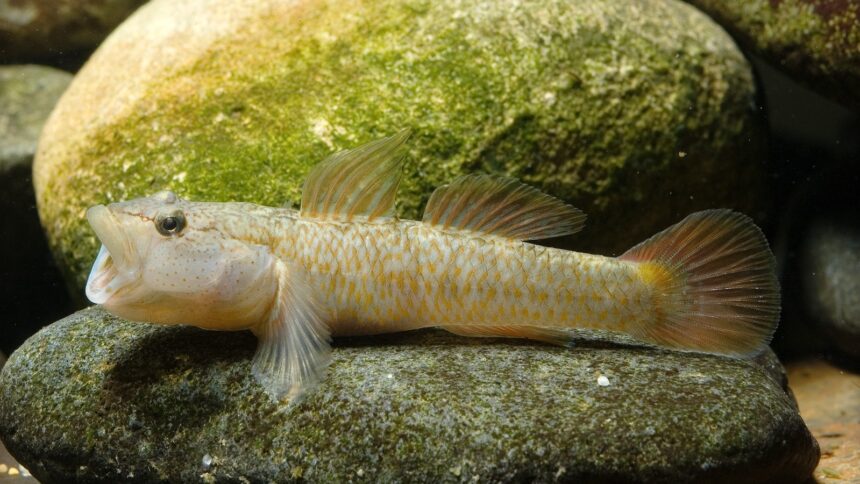
Imagine a tiny fish, less than 20 cm long, scaling vertical cliffs dozens, even hundreds, of metres high. It sounds like a superhero origin story, but it’s real: the remarkable waterfall‑climbing gobies, such as Sicyopterus stimpsoni and Lentipes concolor, perform this extraordinary feat in Hawaiian streams.
Hawaiian gobies have an amphidromous life cycle: eggs hatch in freshwater, larvae drift to the ocean to develop, and juveniles must return upstream to breed and live out their adult lives. To reach predator-free, food-rich habitats, they must climb waterfalls that can reach heights of up to 300 metres, equivalent to a human scaling Mount Everest multiple times.
Their climb resembles scaling a waterfall while being pounded by a fire hose.
evolved some remarkable adaptations to enable them to make this climb. Know about them:
Pelvic sucker: All gobies sport a ventral sucker formed from fused pelvic fins. It allows them to cling to slick rock surfaces in raging currents.
Mouth sucker (only in some species): Sicyopterus stimpsoni, commonly called the Nopili rock-climbing goby, has an extraordinary second suction point, its mouth. During a post-larval metamorphosis, this fish’s mouth shifts underneath its head, turning into a functional sucker.
With both suckers, S. stimpsoni employs a slow, pant‑and‑crawl technique, alternating mouth and belly grip to inch upward.
In contrast, Lentipes concolor and Awaous guamensis ascend waterfalls with rapid tail-undulations and pectoral fin bursts, propelling themselves upward in energetic bursts.
Scientists discovered that the jaw movements used during climbing mirror those the gobies use to feed on algae, a brilliant example of exaptation, where an existing adaptation evolves to serve a new function. Researchers filmed these fish climbing and feeding and revealed nearly identical jaw angles and movements, according to the National Geographic.
These climbs are no easy feat, survival is tough. Only about 10% or fewer of juveniles survive to complete the climb and reach freshwater breeding zones.
Yet, those who succeed help sustain populations in mountain streams, habitats critical to biodiversity. Their presence signals healthy, intact ecosystems.
The waterfall‑climbing goby is a lesson in adaptation, resilience, and evolutionary ingenuity. Its dual-purpose sucker-mouth, life‑cycle journey, and climbing strategy provide fresh insights into biomechanics, evolution, and even biomimetic applications such as improved suction-cup design.
In a world where environmental stressors quickly threaten fragile ecosystems, understanding these fish helps scientists appreciate—and hopefully protect—the amazing wildlife that scales the impossible.