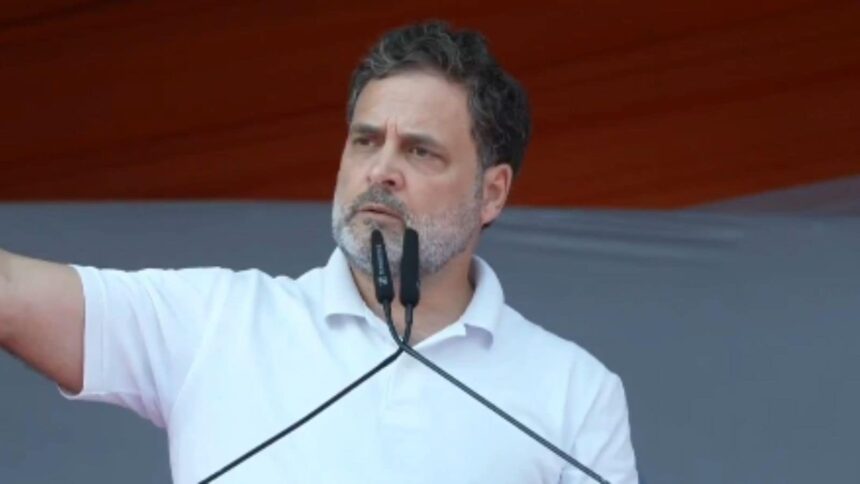
In his first remarks since the situation in West Asia escalated on Sunday and the assassination of Iran’s Supreme Leader, Ayatollah Ali Khamenei, Lok Sabha Leader of Opposition Rahul Gandhi on Tuesday asked if Prime Minister Narendra Modi “supports the assassination of a head of state as a way to define the world order” and said that “silence now diminishes India’s standing in the world”.
Gandhi, who has consistently raised questions over PM Modi’s foreign policy, said: “Escalating hostilities between the United States, Israel and Iran are pushing a fragile region toward wider conflict. Crores of people, including nearly a crore Indians, face uncertainty.”
He said that while security concerns are real, attacks that violate sovereignty will only worsen the crisis. “The unilateral attacks on Iran, as well as Iran’s attacks on other Middle Eastern nations, must be condemned. Violence begets violence – dialogue and restraint remain the only path to peace,” he said in a post on X.
Escalating hostilities between the United States, Israel and Iran are pushing a fragile region toward wider conflict. Crores of people, including nearly a crore Indians, face uncertainty.
While security concerns are real, attacks that violate sovereignty will only worsen the…
— Rahul Gandhi (@RahulGandhi)
Gandhi said that “India must be morally clear” and “should have the courage to speak plainly in defence of international law and human lives”.
“Our foreign policy is rooted in sovereignty and the peaceful resolution of disputes – and it must remain consistent,” said the Congress MP.
“PM Modi must speak up. Does he support the assassination of a head of state as a way to define the world order? Silence now diminishes India’s standing in the world,” wrote Gandhi.
His remarks come on a day when Congress Parliamentary Party chairperson Sonia Gandhi wrote a piece in The titled: “Government’s silence on killing of Iran leader is not neutral, it is abdication.”
The veteran Congress leader and member wrote: “India has long invoked the ideal of vasudhaiva kutumbakam — the world is one family. That civilisational ethos is not a slogan for ceremonial diplomacy; it implies a commitment to justice, restraint and dialogue, even when doing so is inconvenient. At moments when the rules-based order is under visible strain, silence is abdication. India has long aspired to be more than a regional power; it has sought to serve as the conscience-keeper of the world. That stature was built on a willingness to speak for sovereignty, peace, non-violence and justice even when doing so was inconvenient. At this moment, there is an urgent need for us to rediscover that moral strength and articulate it with clarity and commitment.”