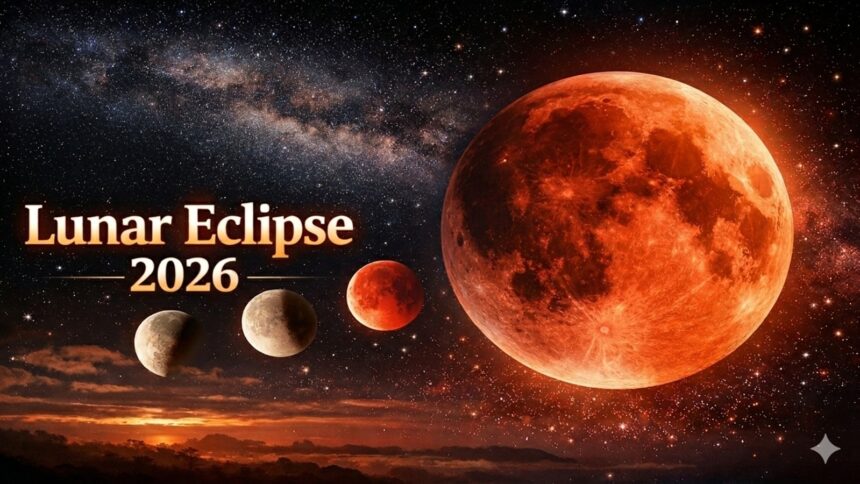
Chandra Grahan (Lunar Eclipse) 2026 Start and End Timings in India: The first total lunar eclipse of 2026 will occur on March 3, offering sky watchers a striking celestial spectacle. In India, the event is known as Chandra Grahan and can be observed safely with the naked eye. No special equipment is required — only a clear sky and an unobstructed view of the horizon.
A lunar eclipse takes place when the Earth moves directly between the Sun and the Moon, casting its shadow on the Moon’s surface. As the alignment progresses, the Moon may appear dimmer and gradually take on a reddish hue — a phenomenon commonly referred to as a “Blood Moon”.
Lunar eclipses occur several times each year globally, but not all are visible from India. That makes this appearance particularly noteworthy for observers in the country.
The lunar eclipse on March 3, 2026, will begin at 3:20 pm and conclude at 6:47 pm (IST). However, only the final phase of the eclipse will be visible in India. Viewers will be able to observe it for approximately 15 minutes — from 6:30 pm to 6:47 pm — shortly after moonrise.
Though a lunar eclipse occurs at the same moment across the globe, it does not appear identical everywhere. The variation in visibility from city to city is largely due to differences in local moonrise times, which are determined by a location’s longitude and the Earth’s rotation. An eclipse can only be observed when the Moon is above the horizon; if it is still below the skyline during the earlier phases, viewers will miss those stages entirely. As a result, cities in the eastern parts of a country often witness more of the eclipse than those in the west, where the Moon rises later. Local terrain and skyline obstructions can further narrow the window of visibility.
A lunar eclipse is among the easiest celestial events to observe — and it requires no special equipment. Unlike a solar eclipse, there is no need for protective glasses. The phenomenon is completely safe to view with the naked eye.
Binoculars can enhance the experience by offering a clearer look at the Moon’s surface as it darkens and changes colour, but they are not essential.
To get the best view, find a location with an unobstructed sightline toward the eastern horizon. If the sky remains clear, you should be able to notice the gradual shift in the Moon’s brightness and its reddish hue as the eclipse progresses.
The total lunar eclipse on March 3, 2026, may be brief for many observers in India. Still, it serves as a reminder that some of the most striking spectacles in the sky require nothing more than looking up.