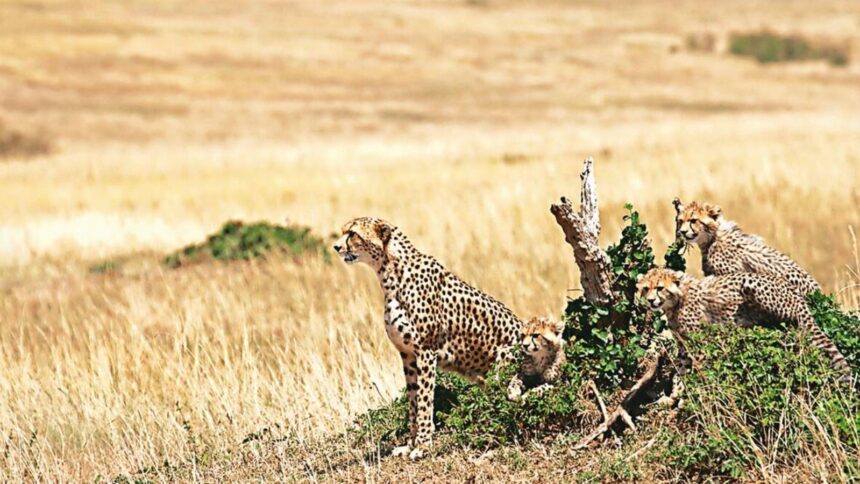
Eight cheetahs from Botswana will be flown into India on Saturday as part of the Centre’s ambitious cheetah reintroduction programme, taking the total number of the big cats in the country to 46. The animals will be released into quarantine enclosures at Kuno National Park in Madhya Pradesh, where officials will closely monitor their health and behaviour before gradually preparing them for life in the wild.
The batch, comprising six females and two males, will be airlifted from Botswana to Gwalior on an Indian Air Force (IAF) aircraft, and then transported to Kuno by helicopter.
Madhya Pradesh Chief Minister and Union Environment, Forest and Climate Change Minister Bhupender Yadav are scheduled to oversee the release of the animals into specially prepared enclosures at the park.
Project Director Uttam Sharma told The that the cheetahs are expected to reach Kuno between 9 am and 10 am on Saturday after an intercontinental flight that takes around 9-10 hours. He said the park has readied multiple quarantine enclosures and five helipads to ensure a smooth and stress-free transfer of the animals. “Our aim will be to boost the cheetah population to over 50. We have not taken a call on shifting the cheetahs to the Gandhi Sagar wildlife sanctuary,” Sharma said.
This is the third batch of African cheetahs brought to India under the translocation programme, following earlier introductions from Namibia in September 2022 and South Africa in February 2023. The latest transfer from Botswana is part of a government-to-government agreement aimed at establishing a genetically diverse, free-ranging cheetah population in India over the next decade.
Under the protocol, the cheetahs will remain in large, fenced enclosures for about a month. During this period, wildlife veterinarians and forest officials will monitor their feeding patterns, movement, adaptation to local climate, and any signs of stress or disease. Blood samples and health parameters will be assessed regularly. The cheetahs will soon be fitted with GPS satellite collars, which will be checked to ensure real-time tracking once the animals are eventually released into larger soft-release areas.
Officials said the enclosure phase is critical to minimise mortality risks, particularly after earlier setbacks in the project. The animals are kept in isolation initially to prevent the spread of disease and to help them acclimatise to Indian prey species and terrain. Only after they demonstrate stable health and hunting behaviour will they be moved to open forest compartments.
With the arrival of the Botswana batch, the number of cheetahs in India will rise to 46. At present, 35 cheetahs are housed at Kuno, while three have been relocated to Gandhi Sagar Wildlife Sanctuary in Mandsaur district to reduce the risk of disease outbreaks and pressure on a single habitat.
India’s cheetah reintroduction programme marks the return of the species nearly 70 years after it was declared extinct in the country. Since 2023, 39 cubs have been born at Kuno, of which 27 have survived. Officials said that last year saw mixed outcomes, with 12 cubs born but six, including three cubs, failing to survive. This year, eight cubs were born in two litters between February 7 and February 18. Wildlife officials announced that Gamini, which recently gave birth to three cubs, has also given birth to an additional cub.
Namibia-born Jwala and Aasha, South Africa-born Gamini, Veera and Nirva, and India-born Mukhi have all produced litters at Kuno, officials said, adding that dispersing cheetahs across multiple sites is central to the long-term success of the project.