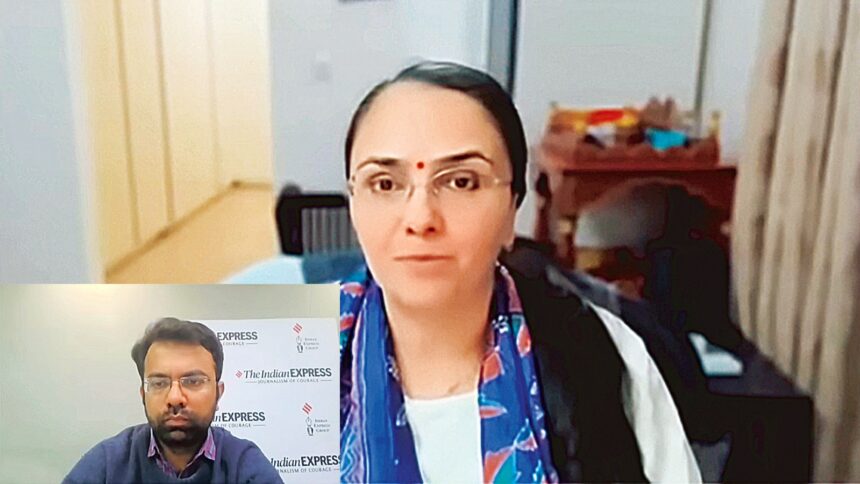
Prachi Mishra is Professor of Economics, Director and Head of the Isaac Centre for Public Policy, Ashoka University. Previously, she has worked for the RBI, the Union Finance Ministry and the IMF. She was also India chief economist for Goldman Sachs. She spoke to Siddharth Upasani, Deputy Associate Editor at The Indian Express, on the Budget, the new fiscal anchor and boosting private capex
Debt and fiscal deficit are two sides of the same coin. While debt-to-GDP is the anchor, the operational target has to be fiscal deficit-to-GDP, which the government has specified for next year. Now, the way I would interpret it — and this follows the recommendation of the Fiscal Responsibility and Management Review Committee — is that the government’s fiscal strategy is now anchored in public debt with specific annual debt targets, and the goal is to bring down debt-to-GDP ratio to 50% +/- 1% by 2030-31.
Two things: one, nominal (GDP) growth is a very important variable in any debt sustainability analysis — how much capacity you have to pay off your debt over time. And the central government’s debt anchor would be tough to achieve if nominal growth numbers surprise to the downside.
Second, states are a big part. Overall, states’ debt is about 28% of GDP. So, if you take into account both the Centre and states, our sovereign debt is about 83% of GDP. It remains high, and that’s what markets and credit rating agencies would ultimately care about. And overall sovereign borrowing is important because it also determines the debt service costs.
I think it’s very important to anchor our fiscal policy in terms of debt, because debt does matter. Higher debt is associated with higher debt servicing costs, and that can have opportunity costs and other consequences.
I think this question should be asked to the industry leaders: what would it take to get a broader capex cycle going, and what else can the government do to encourage them to invest big? If you look at the aggregate data — at least aggregate macro data — private corporate investment is fairly stagnant at around 10-11% of GDP. There are green shoots: for example, if you look at the FICCI manufacturing index, it is at an all-time high. Capacity utilisation is still below long-term historical averages but still has gone up to 75%. Bank balance sheets are cleaned up: gross NPAs are 2.1%, net NPAs are almost zero.
Probably, firms are exhibiting strategic caution as they digest global trade uncertainties, and they’re being prudent rather than speeding up to arrive at the next capex cycle. I’m hoping that the (India-US) trade deal, giving a big fillip to external demand, can be the catalyst for a broad private capex cycle by reducing not only tariffs but also uncertainty.
What struck me about the Budget is that a lot of it was about the painstaking process and institutional reforms, which are essential to sustaining India’s growth momentum.
In my view, having a committee to assess where banking stands is a terrific idea: how big we need banks to be, how should the banking system or non-banks evolve. I don’t know what the committee mandate will be — only banks or we’ll consider non-banks as well — but this is a great time, given that we want a sustained growth momentum of between 7-8% over the next 20 years. Given that net household financial savings have been declining as households are getting more matured and are leveraging more, who will fund this growth going forward? And what role banks and other sources of credit or non-bank sources of funds will play is an excellent idea.
The Budget is essentially an accounting exercise, but it also becomes (a way) to assess the vision of the government going forward. For a common person, to think about what the Budget does for jobs and for infrastructure — if the economy is growing fast, if we are creating enough in an inclusive and employment-generating way — should be very important. So, beyond how the Budget presents itself not merely as a statement of financial accounts, (but) how it reflects the government’s priorities and reveals its theory of economic development is something to keep in mind.