



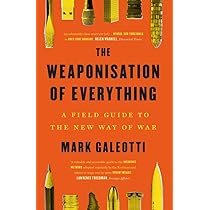
The Weaponization of Everything: How Finance, Energy & Data Became New Arenas of Conflict
The classic image of war—tanks rolling across borders, dogfights in the skies, and soldiers in trenches—is becoming a relic of a bygone era. While conventional military power remains a crucial deterrent, the primary battlegrounds of 21st-century geopolitical conflict have shifted. Today, nations are waging war not with bullets and bombs, but with bank transfers, energy flows, and lines of code. We have entered an era where everything—from the money in our banks to the data on our phones and the energy that powers our homes—can be weaponized.
This is the age of “hybrid warfare,” where the lines between war and peace are blurred, and the tools of daily life are transformed into instruments of strategic coercion. Understanding this shift is essential to deciphering the complex, often invisible, conflicts that are reshaping the global order.
Part 1: The Financial Arsenal – Sanctions as the New Siege Warfare
In the modern era, the most powerful weapon is often not a missile, but a financial sanction. Where medieval armies would lay siege to a castle to starve it into submission, today’s powers lay siege to entire economies.
The Case of Russia: The Financial “Special Military Operation”
The Western response to Russia’s invasion of Ukraine unleashed the most sophisticated and comprehensive financial warfare campaign in history. This was not a simple freeze on assets; it was a multi-pronged assault designed to cripple the Russian economy and degrade its war-fighting capacity.
-
The Central Bank Blitzkrieg: The most devastating move was the freeze of approximately $300 billion of Russia’s central bank reserves held in Western jurisdictions. This was the economic equivalent of destroying an enemy’s ammunition dump before the battle even begins. It prevented Russia from using its war chest to support the ruble and finance its military, instantly halving its available reserves.
-
The SWIFT Exclusion: Kicking select Russian banks out of the SWIFT messaging system—the global plumbing of international finance—was like severing a nation’s digital arteries. It dramatically complicated Russia’s ability to receive payments for its exports and pay for its imports, causing immediate commercial paralysis.
-
Smart Sanctions and Elites: Beyond broad economic measures, “smart” or targeted sanctions were deployed against oligarchs, political elites, and their families. This was designed to create internal pressure on the Kremlin by turning the influential class that props up the regime into a liability.
The New Reality: The weaponization of finance has demonstrated that in a globalized economy, a nation’s wealth can be held hostage by the international system it relies on. This has sent shockwaves through every major economy, particularly China, which is now acutely aware of its vulnerability and is actively building financial escape routes.
Part 2: The Energy Gambit – Pipelines as Strategic Weapons
Energy, particularly natural gas, has long been a tool of Russian foreign policy. The war in Ukraine transformed this tool into an overt weapon.
-
The Prelude to War: The Weaponization of Dependence: For decades, Europe consciously grew dependent on cheap Russian gas, building a web of pipelines like Nord Stream. Moscow cultivated this dependence, using it to divide European nations and discourage a unified foreign policy. It was a long-term strategic play that gave Russia enormous leverage.
-
The Winter Offensive: When the invasion began, Russia did not just turn off the taps. It engaged in a deliberate campaign of energy blackmail, gradually reducing and then cutting off gas flows to Europe. The goal was clear: to trigger an economic crisis, social unrest, and fracture European solidarity with Ukraine as citizens faced a freezing, unaffordable winter.
-
The Counter-Strategy: Energy Fortress Europe: Europe’s response was a masterclass in adapting to hybrid warfare. It launched a frantic and successful global search for alternative Liquefied Natural Gas (LNG) supplies, accelerated its green energy transition, and implemented mandatory gas rationing. By breaking its addiction, Europe called Russia’s bluff and fundamentally undermined its primary strategic weapon. The subsequent sabotage of the Nord Stream pipelines symbolized the irreversible severing of this energy relationship.
This conflict proved that energy infrastructure is not just economic; it is critical national security infrastructure, and over-reliance on a strategic adversary is a catastrophic vulnerability.
Part 3: The Digital Battlefield – Cyberattacks and the War on Critical Infrastructure
If financial warfare targets a nation’s economy and energy warfare targets its comfort, cyber warfare targets its very ability to function. This is conflict waged in the shadows, with the potential for paralyzing effects that rival those of a traditional military strike.
-
From Espionage to Sabotage: Cyber operations have evolved from stealing secrets to actively disrupting and destroying physical infrastructure. The Stuxnet worm, which destroyed Iranian centrifuges, was a seminal moment, proving that a digital attack could cause tangible, physical damage.
-
The Rise of “Below-the-Threshold” Warfare: Nations now constantly probe and attack each other’s critical infrastructure—power grids, water systems, financial networks, and hospitals—at a level that falls just short of triggering a traditional military response. Russia has been a pioneer in this domain, having previously shut down parts of Ukraine’s grid and tested the defenses of Western energy and electoral systems.
-
The Hacker-Mercenary: The lines between state and non-state actors are blurred. Groups like Russia’s Cozy Bear and China’s APT41 operate with state tolerance or direction, providing plausible deniability while conducting sophisticated espionage and disruptive campaigns. The ransomware epidemic, often emanating from Russian-speaking gangs, functions as a form of asymmetric economic warfare, extracting billions from Western companies and municipalities.
The digital battlefield is unique because it is always active. There are no front lines, and every connected device is a potential vulnerability.
Part 4: The Data Domain – Information as a Tool for Subversion
In the 21st century, data is the new oil, and like oil, it can be weaponized. The battlefield is the human mind itself.
-
The Attention Economy of Disinformation: State actors, most notably Russia, have weaponized social media algorithms to wage information warfare. By flooding digital spaces with disinformation, conspiracy theories, and divisive content, they aim to erode trust in democratic institutions, amplify social divisions, and paralyze the political will of their adversaries. The goal is not to convince people of a single truth, but to create a world of such confusion and cynicism that no truth is trusted.
-
Surveillance as Coercion: The Chinese government has turned data collection into a core tool of state control, both domestically and abroad. Through its Great Firewall, social credit system, and the global reach of companies like Huawei and TikTok (which is a subject of intense scrutiny), it harvests vast amounts of data. This data can be used for domestic surveillance, intellectual property theft, or building detailed profiles for future coercion of foreign individuals and officials.
Part 5: Fortifying the New Frontier – The Global Response
In the face of this multi-domain weaponization, nations are scrambling to build economic and digital fortresses—a process often termed “de-risking” or “resilience.”
-
Financial Fortifications: Countries are exploring Central Bank Digital Currencies (CBDCs) and promoting alternative payment systems (like China’s CIPS) to create SWIFT-independent channels. There is a strategic push to “friend-shore” supply chains and hold larger reserves of critical minerals to avoid future economic coercion.
-
Energy Sovereignty: The European experience has triggered a global rush for energy independence through renewables, nuclear power, and diversified LNG imports. Energy security is now synonymous with national security.
-
Cyber Deterrence and Defense: Nations are establishing Cyber Commands, publicly attributing attacks to shame adversaries, and threatening proportional responses. The concept of a “Cyber NATO”—where an attack on one member is treated as an attack on all—is being actively debated. Critical infrastructure is being hardened, and public-private partnerships are essential for national cyber defense.
The Permanently Contested World
The weaponization of everything has created a world of permanent, low-grade conflict. The battlefields are no longer just in disputed territories; they are in our stock markets, our energy grids, our social media feeds, and our digital wallets. Victory in this new era is not measured in territory captured, but in economic resilience sustained, critical infrastructure defended, and public trust preserved.
This new form of warfare favors the agile, the technologically advanced, and the resilient. It demands a holistic view of national power, where diplomats, economists, cyber experts, and energy analysts are as crucial as generals. The age of pure military dominance is over. We have entered an era where the most potent threats may not come from a foreign army, but from a silent cyberattack on our power grid, a coordinated run on our currency, or a sophisticated campaign to tear our society apart from within. In the weaponized world, defense is no longer just a military matter—it is a societal imperative.

