



Climate Wars: The Looming Crisis of Water, Food, and Mass Migration
The conversation around climate change has long been framed in environmental terms—melting ice caps, endangered species, and carbon ppm. While these are critically important, this framing has allowed many to view climate change as a distant, abstract concern. This is a catastrophic miscalculation. Climate change is not merely an environmental issue; it is the ultimate “threat multiplier,” a fundamental driver of human insecurity that is already fueling conflicts, destabilizing nations, and setting the stage for unprecedented global crises.
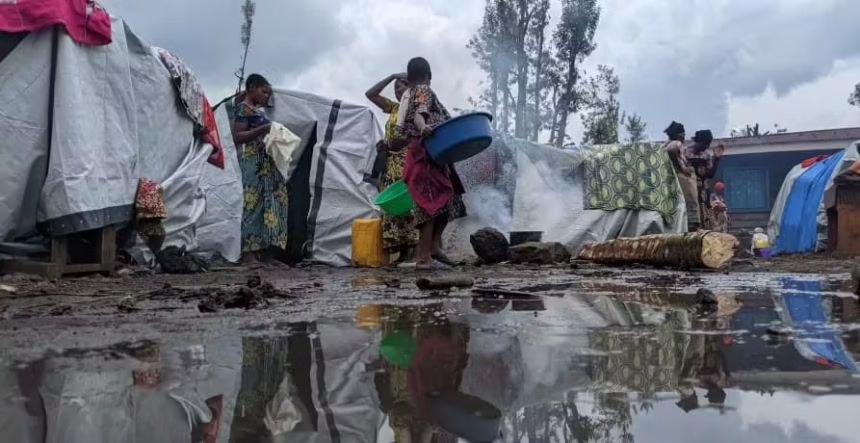
We are entering the era of “Climate Wars”—not wars fought over ideology or religion alone, but conflicts ignited by the scarcity of the most basic resources for survival: water, food, and habitable land. This is a story of how rising temperatures are translating directly into rising tensions, and how the changing climate is becoming the most powerful geopolitical force of the 21st century.
Part 1: The Threat Multiplier – How Climate Change Ignites Conflict
Climate change does not typically create new conflicts from nothing. Instead, it intensifies existing social, economic, and political fault lines. It acts as a catalyst, pushing fragile situations over the edge into violence and collapse. The mechanisms are clear:
-
Resource Scarcity: As water sources dry up and fertile land turns to dust, competition for what remains becomes a zero-sum game.
-
Economic Shock: The collapse of agriculture—the primary livelihood for billions—creates mass unemployment, poverty, and desperation.
-
Forced Displacement: When land becomes uninhabitable, people are forced to move, often into areas occupied by other groups, leading to social friction and conflict.
-
Loss of Legitimacy: Governments that fail to provide basic resources like water and food lose the trust of their people, creating a vacuum that can be filled by extremist groups or warlords.
Part 2: The First Frontline – The Sahel and the War for Water and Land
Nowhere is the link between climate and conflict more starkly visible than in the Sahel region of Africa, a vast semi-arid belt south of the Sahara.
The Vicious Cycle:
-
Rapid Desertification: The Sahara Desert is expanding southward at an alarming rate, devouring arable land. Lake Chad, once a life source for 30 million people, has shrunk by 90% since the 1960s due to climate change and overuse.
-
Collapse of Livelihoods: Farmers and pastoralists who have coexisted for centuries now find their traditional ways of life impossible. Herders are forced to drive their cattle onto farmers’ lands in search of water and pasture.
-
Escalation to Violence: This competition for dwindling resources has erupted into intense, widespread violence. In countries like Nigeria, Mali, and Burkina Faso, clashes between farmers and herders have become deadlier than the terrorist attacks of Boko Haram or Al-Qaeda affiliates.
-
Exploitation by Extremists: Jihadist groups expertly exploit this desperation. They offer marginalized communities protection, a share of looted resources, and a sense of purpose, easily recruiting from the pools of disaffected, unemployed youth. They position themselves as the only providers of security and justice in regions where the state has utterly failed.
The conflict in Darfur was one of the world’s first documented “climate wars,” and the same tragic script is now playing out across the entire Sahel. This is not a coincidence; it is a causal chain with climate change at its origin.
Part 3: The Gathering Storm – South Asia’s Looming Water and Migration Crisis
If the Sahel represents the present-day frontline, South Asia represents the epicenter of a future crisis of unimaginable scale.
The Himalayan Water Tower in Peril:
The glaciers of the Himalayas and the Hindu Kush are the source of Asia’s ten major river systems, including the Ganges, Indus, and Brahmaputra. These rivers are the arterial lifelines for nearly two billion people—a quarter of humanity. They provide water for drinking, agriculture, and industry across India, Pakistan, Bangladesh, China, and Nepal.
-
The Paradox of Glacial Melt: Initially, accelerated melting will cause increased flooding. But once the glaciers recede significantly, the flow will become erratic and then sharply decline, leading to permanent drought for the most densely populated river basins on Earth.
-
Transboundary Water Wars: The management of this crisis is fraught with geopolitical peril. India and Pakistan, nuclear-armed rivals, have a fragile water-sharing agreement over the Indus. China, controlling the headwaters of many major rivers, is building massive dams, giving it strategic leverage over downstream nations. As scarcity bites, hydro-politics will become a primary source of international tension, with the very real potential for conflict.
The Delta Doomsday: Rising Seas in Bangladesh
While some regions face a shortage of water, others face its terrifying excess. Bangladesh, a nation of 170 million people built on a low-lying river delta, is ground zero for sea-level rise.
-
Salinization and Displacement: Saltwater is encroaching inland, poisoning agricultural land and freshwater supplies. Storm surges from increasingly powerful cyclones are inundating coastal regions. It is estimated that by 2050, one in every seven people in Bangladesh will be displaced by climate change. That translates to over 20 million internal climate refugees.
-
The Spillover Effect: Where will these millions go? The most logical destination is neighboring India. This will inevitably strain resources and ignite ethnic and religious tensions in India’s already volatile northeastern states, potentially creating a massive regional security and humanitarian catastrophe.
Part 4: The Global Ripple Effect – Food Shocks and Political Instability
The impacts of climate-driven crises are not contained within national borders. In our interconnected global economy, a drought in one breadbasket can trigger political unrest on the other side of the world.
The 2008 Precedent: A Warning Ignored
In 2007-2008, a perfect storm of crop failures in key exporting nations, high oil prices, and speculative activity led to a dramatic spike in global food prices. The result was the “Arab Spring.” Soaring bread prices were the primary spark for the revolutions in Egypt and Tunisia, where the slogan was “Bread, Freedom, Social Justice.” The wave of unrest toppled governments and plunged the Middle East into a decade of instability.
The Future is More Fragile:
Climate change makes such synchronized crop failures more likely. A heatwave devastating the Russian wheat harvest, a drought in the US Midwest, and flooding in Southeast Asia could occur simultaneously, creating a global food price shock that would make 2008 look mild.
-
Vulnerable Nations: Countries in the Middle East and North Africa that are heavily reliant on food imports (like Egypt, the world’s largest wheat importer) are sitting on a political powder keg.
-
The Rise of Xenophobia and Authoritarianism: In wealthier nations, food insecurity and waves of climate migrants will fuel the politics of fear, xenophobia, and isolationism. We have already seen the political impact of the 2015 Syrian refugee crisis in Europe; the climate-driven migrations of the future will be orders of magnitude larger.
Conclusion: From Mitigation to Adaptation – The New Security Imperative
The era of Climate Wars is no longer a dystopian future; it is our present reality. The conflicts in the Sahel, the tensions in South Asia, and the food price shocks of the past are all early tremors of a coming earthquake.
This new reality demands a fundamental shift in how we think about security. National security can no longer be defined solely by military might and border walls. It must be redefined to include:
-
Water Security: Ensuring sustainable management of transboundary water resources.
-
Food Security: Building resilient agricultural systems and strategic food reserves.
-
Human Security: Investing in social safety nets, healthcare, and disaster preparedness for vulnerable populations.
The choice before the global community is stark. We can continue to treat climate change as a peripheral environmental issue, responding to each new crisis—each new “climate war”—with reactive, short-term humanitarian aid and military interventions. This is a path that leads to a world of fortified borders, perpetual conflict, and immense human suffering.
Alternatively, we can recognize climate change for what it is: the central, overarching security challenge of our time. This requires a Marshall Plan-level of investment in climate adaptation—in drought-resistant agriculture, water conservation infrastructure, and early warning systems. It demands that we view development aid not as charity, but as strategic investment in global stability.
The climate wars have begun. The question is whether we will have the wisdom to fight them not against each other, but against their root cause. The future of global peace depends on the answer.

