



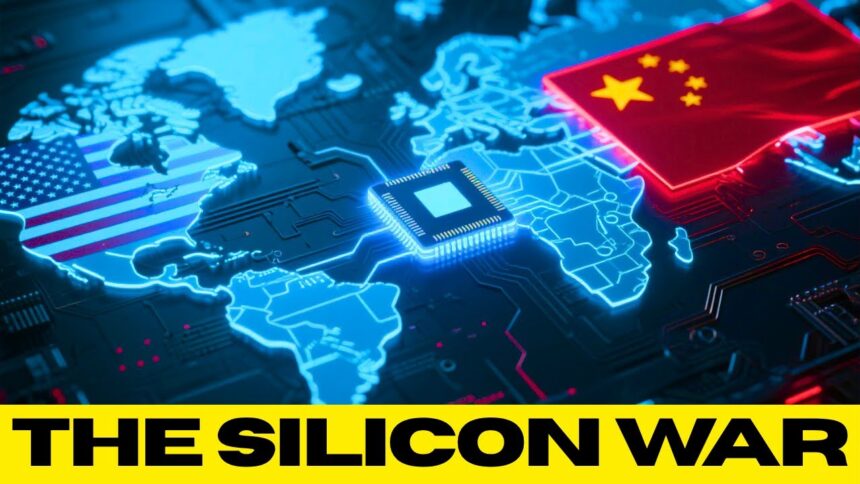
The Silent War: Unpacking the Global Battle for Semiconductor Supremacy
Beneath the headlines of territorial disputes and trade wars, a far more consequential, high-stakes conflict is being waged. It is a silent war, fought not with soldiers and missiles, but in sterile cleanrooms, through billion-dollar investments, and in the halls of power from Washington to Beijing. The prize is not land or oil, but the foundational technology of the 21st century: the semiconductor.
These tiny, intricately etched pieces of silicon are the brains of modern civilization. They power everything from smartphones and cars to advanced weapons systems and artificial intelligence. Their strategic importance has catapulted them to the center of a global geopolitical struggle, transforming them into the “new oil”—a resource so critical that national security and economic prosperity are now inextricably linked to its supply.
This is the story of the silent war for chip supremacy, a conflict that will define the balance of power for decades to come.
Part 1: Why Chips are the “New Oil” – The Bedrock of Modern Geopolitics
To understand the conflict, one must first appreciate why a component smaller than a fingernail commands such immense power.
-
Economic Ubiquity: The global economy runs on semiconductors. The COVID-19 pandemic provided a brutal lesson in this dependency. A shortage of a $1 chip brought the $3 trillion global automotive industry to a halt, idling factories and highlighting how every modern industry, from consumer electronics to healthcare, is built upon a foundation of silicon.
-
Military Superiority: Advanced semiconductors are the cornerstone of modern warfare. They enable the precision in guided missiles, the processing power in fighter jet avionics, the encryption in secure communications, and the artificial intelligence used for battlefield simulation and drone swarms. A nation’s military edge is now directly proportional to its access to the most advanced computing power.
-
The AI & Data Economy: The race for artificial intelligence supremacy is, at its core, a race for computational power. Training large language models like GPT-4 requires thousands of the most advanced graphics processing units (GPUs). The nation or company that leads in AI will dictate the future of technology, and that leadership is impossible without a secure, cutting-edge supply of semiconductors.
Part 2: The Global Chessboard – Concentrated Power and Strategic Vulnerabilities
The semiconductor supply chain is a marvel of globalized efficiency, but it is also a monument to extreme concentration and profound vulnerability.
1. Taiwan: The Epicenter of the Storm
The island nation of Taiwan is the undisputed linchpin of the global tech economy. Its champion, the Taiwan Semiconductor Manufacturing Company (TSMC), represents a staggering 90% of the world’s production of the most advanced semiconductors (below 10 nanometers).
-
The “Silicon Shield”: TSMC’s unparalleled expertise and capacity have been described as a “Silicon Shield,” a deterrent against Chinese aggression due to the global economic catastrophe that would follow any disruption. However, this also makes Taiwan the single greatest point of failure in the global supply chain.
-
The “Foxconn” Precedent: China’s claim over Taiwan is a core national objective. A military conflict or even a blockade over the Taiwan Strait would instantly sever the world from the most advanced chips, triggering a global economic depression far worse than 2008. The production of iPhones, PlayStations, cloud computing infrastructure, and advanced medical equipment would cease.
2. South Korea & Samsung: The Other Titan
South Korea’s Samsung is the only other company that can compete with TSMC at the leading edge of chip manufacturing. Along with SK Hynix, a leader in memory chips, South Korea controls a massive portion of the global semiconductor market. This makes it a crucial US ally and a key player in the geopolitical balancing act with China.
3. The United States: Design Powerhouse, Manufacturing Anxiety
The US remains the global leader in chip design, home to giants like Intel, AMD, Nvidia, and Apple, and the software (EDA tools) needed to create blueprints for chips. However, its share of global semiconductor manufacturing has plummeted from 37% in 1990 to just 12% today. This over-reliance on Asia for fabrication is viewed in Washington as an unacceptable strategic vulnerability.
4. China: The Ambitious Challenger
China is the world’s largest consumer of semiconductors, but it remains heavily dependent on foreign technology, particularly from the US and Taiwan. Being cut off from this supply, as seen with the Huawei sanctions, is a national security nightmare for Beijing. The Chinese government is pouring billions into its “Made in China 2025” policy to achieve self-sufficiency, but it remains years, if not decades, behind in producing the most advanced chips.
5. The European Union: The Anxious Regulator
The EU, home to key chip equipment makers like ASML (Netherlands) and Infineon (Germany), watched the chip shortage cripple its auto industry. It has now launched its own European Chips Act, aiming to double its global market share to 20% by 2030, recognizing that technological sovereignty is impossible without a secure supply of semiconductors.
Part 3: The Battle Lines Are Drawn – The CHIPS Act and the Tech Cold War
The geopolitical conflict has moved from theory to action, with the United States launching a full-scale offensive to re-shore and secure the semiconductor supply chain.
The US CHIPS and Science Act: A $280 Billion Gambit
This landmark legislation is the most significant industrial policy move by the US in decades. It provides over $52 billion in subsidies for domestic semiconductor research and manufacturing. Its goals are unequivocally geopolitical:
-
Reduce Dependency on Asia: By incentivizing TSMC, Samsung, and Intel to build massive, state-of-the-art fabs (fabrication plants) in Arizona and Ohio, the US aims to create a secure, domestic source for the most advanced chips.
-
Slow China’s Progress: The Act includes “guardrails” that prevent recipients of US funding from expanding their advanced chip manufacturing capacity in China for a decade. This is a direct attempt to stymie Beijing’s technological ascent.
The Export Control Hammer
Complementing the CHIPS Act’s carrots are the sticks of export controls. In a series of sweeping moves, the US Bureau of Industry and Security (BIS) has:
-
Cut off China from advanced AI chips designed by companies like Nvidia and AMD.
-
Blocked Chinese companies’ access to the advanced equipment (from US firms like Applied Materials and Lam Research) needed to make cutting-edge chips.
-
Lobbied allies like the Netherlands and Japan to restrict their companies (most critically, ASML, the only maker of Extreme Ultraviolet (EUV) lithography machines essential for 5nm chips and beyond) from selling to China.
These measures represent a technological blockade, aimed at crippling China’s ability to produce the chips needed for AI development and advanced weapons systems.
Part 4: The Immense Challenge of Decoupling – A $1 Trillion Headache
While the political will is clear, the practical challenges of rebuilding the world’s most complex supply chain are Herculean.
-
The Cost and Complexity Barrier: A single advanced fab costs over $20 billion to build and requires a continuous supply of ultra-pure water and reliable, massive amounts of electricity. More critically, it requires a deep ecosystem of specialized suppliers and, most importantly, a highly skilled workforce that takes years to develop. The US and EU cannot simply buy their way to instant self-sufficiency.
-
The Innovation Slowdown: The current, hyper-specialized global model has driven relentless innovation. Forcing a decoupling into separate US/Western and Chinese tech spheres could slow the pace of progress for everyone, as R&D costs soar and collaborative efficiencies are lost.
-
China’s Response: Beijing is responding with a full-force national effort to break through the technological blockade, investing heavily in its own champions like SMIC and YMTC. While it faces immense hurdles, the history of technological development suggests that with enough resources and focus, it will eventually make progress, potentially creating a parallel, China-centric tech ecosystem.
Conclusion: The Unwinnable War and the New World Order
The silent war for semiconductors is not a conflict that will end with a clear victor and vanquished. It is a permanent, ongoing struggle that will define the new world order.
The most likely outcome is a “bifurcated” global technology landscape: one bloc led by the US and its allies, with supply chains running through Taiwan, South Korea, and new fabs in America and Europe; and another, less advanced bloc led by China, relying on its own domestic capacity and technology from non-aligned nations.
This bifurcation carries profound risks:
-
For Consumers: It could lead to higher prices for electronics as duplicate, less efficient supply chains are built.
-
For Global Stability: It solidifies the divide between democratic and authoritarian techno-spheres, reducing economic interdependence and potentially making direct conflict more likely.
-
For Innovation: It may slow the breakneck pace of Moore’s Law, as the collective brainpower and resources of the global tech community are fragmented.
The tiny semiconductor has become the canary in the coal mine for globalization itself. The era of frictionless global supply chains is over, replaced by an era of techno-nationalism where chips are treated as strategic assets. The silent war is, therefore, a war for the future—and every nation, company, and citizen has a stake in its outcome.

