The De-Dollarization Dream? BRICS and the Forging of a Multipolar World Order
The post-Cold War era, characterized by uncontested American hegemony and the liberal international order, is undergoing a profound transformation. The unipolar moment has passed, giving way to a more fragmented, contested, and multipolar global landscape. At the heart of this geopolitical shift is BRICS—an acronym that has evolved from an economic forecasting term into a formidable political bloc representing the most significant challenge to Western-dominated institutions in decades.
Originally comprising Brazil, Russia, India, China, and South Africa, BRICS has long been viewed with skepticism by Western analysts, often dismissed as an unwieldy coalition of disparate nations with conflicting interests. However, the group’s sustained momentum, its ambitious expansion in 2024, and its coherent mission to reshape the architecture of global governance demand a serious reassessment. BRICS is no longer just a talking shop; it is the primary vehicle for the “Global South” to articulate an alternative vision for the world order. This analysis delves into the historical context, the strategic drivers, the internal contradictions, and the future trajectory of this pivotal alliance.
Part 1: From Acronym to Alliance – The Genesis and Evolution of BRICS
The story of BRICS begins not in a diplomatic conference, but in an investment bank. In 2001, Goldman Sachs economist Jim O’Neill coined the term “BRIC” to highlight the immense economic potential of Brazil, Russia, India, and China. The grouping was formalized in 2009, holding its first summit in Yekaterinburg, Russia. South Africa was invited to join in 2010, adding a crucial African voice and completing the “S” in BRICS.
The initial focus was overwhelmingly economic, rooted in a shared frustration with the existing global financial system. The founding members, despite their different political systems, found common cause in several key areas:
-
Underrepresentation in Global Institutions: The International Monetary Fund (IMF) and the World Bank, created in 1944, still reflect the power dynamics of the mid-20th century. Voting shares and leadership positions remain heavily skewed towards the United States and Europe, despite BRICS economies collectively rivaling the G7 in terms of purchasing power parity.
-
The Dominance of the US Dollar: The dollar’s status as the world’s primary reserve currency gives the United States unparalleled financial power, including the ability to impose devastating sanctions through its control of the global payments system (e.g., SWIFT). This “exorbitant privilege” is viewed by BRICS members as a strategic vulnerability.
-
Shared Developmental Challenges: As large, populous nations undergoing rapid development, they face similar challenges in infrastructure, poverty alleviation, and industrialization, creating a natural platform for knowledge sharing and mutual support.
Part 2: The Pillars of the BRICS Project – Building an Alternative Ecosystem
BRICS’s strategy is not to violently overthrow the existing order, but to build a parallel ecosystem of institutions and frameworks that provides its members with strategic autonomy and dilutes Western influence. This is achieved through several concrete pillars:
1. The New Development Bank (NDB): Established in 2014 with an initial authorized capital of $100 billion, the NDB is the bloc’s most tangible achievement. Dubbed the “BRICS Bank,” its explicit mandate is to “mobilize resources for infrastructure and sustainable development projects in BRICS and other emerging economies.” The NDB represents a direct challenge to the World Bank, offering loans with fewer political conditionalities and focusing on priorities defined by the Global South itself. It aims to finance projects in local currencies, a crucial step towards reducing dollar dependency.
2. The Contingent Reserve Arrangement (CRA): Created alongside the NDB, the CRA is a $100 billion pool of currency reserves designed to provide BRICS members with a safety net during balance of payments crises. It functions as an alternative to the IMF, allowing members to access emergency funding without submitting to the stringent, often politically charged, austerity measures typically imposed by the Fund.
3. Economic De-Dollarization: This is the bloc’s most ambitious and complex goal. The weaponization of the dollar through sanctions against Russia has injected new urgency into this effort. BRICS is actively promoting:
-
Local Currency Settlement: Encouraging bilateral trade to be invoiced and settled in national currencies like the Chinese Renminbi, Indian Rupee, or Russian Ruble.
-
Exploring a Common BRICS Currency: While a unified currency remains a distant and logistically fraught prospect, the fact that it is being seriously discussed signals the depth of the bloc’s ambition to create an independent financial system.
4. Political and Diplomatic Coordination: Beyond economics, BRICS acts as a powerful diplomatic caucus. It provides a platform for its members to coordinate positions on major global issues, from climate change to Syria, often presenting a unified front that contrasts with the G7. This challenges the West’s monopoly on setting the global agenda and provides a counterweight to what is often perceived as unilateralism.
Part 3: The Great Expansion and the Forging of “BRICS-Plus”
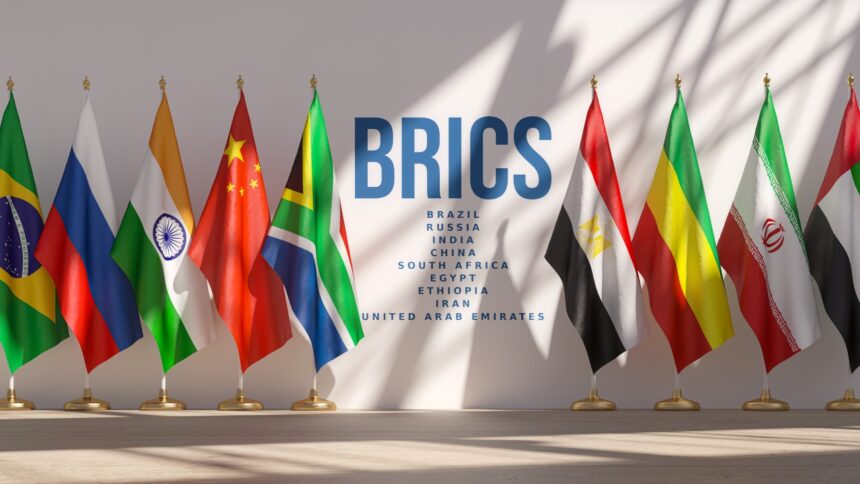
The year 2024 marked a watershed moment for the bloc. At its summit in South Africa, BRICS undertook its most significant expansion in over a decade, inviting six new full members: Egypt, Ethiopia, Iran, Saudi Arabia, the United Arab Emirates, and Argentina (though Argentina later declined under its new president).
This expansion is strategically transformative:
-
Geographic and Strategic Heft: It brings in major energy producers (Saudi Arabia, UAE, Iran), key regional powers (Egypt, Ethiopia), and critical maritime chokepoints. This turns BRICS from a continental bloc into a global network with direct influence over the world’s most vital trade routes and energy supplies.
-
The “Global South” Embodied: The expanded BRICS now represents over 40% of the world’s population and a significant share of global GDP. It is becoming the undeniable institutional voice for the non-Western world.
-
A Direct Challenge to the G7: The inclusion of major U.S. allies like Saudi Arabia and the UAE signals a profound geopolitical realignment. These nations are hedging their bets, seeking strategic autonomy and a multipolar world where they are not beholden to a single superpower.
Part 4: The Internal Fault Lines – Contradictions and Challenges
For all its momentum, BRICS is not a monolithic entity. Its strength is also its greatest weakness: its diversity. The bloc is riddled with internal contradictions that could hinder its ability to act as a cohesive force.
-
The India-China Rivalry: The persistent and often violent border disputes between India and China represent the most significant internal fissure. India is deeply wary of Chinese hegemony within the group and views Beijing’s Belt and Road Initiative (BRI) as a strategic threat. This rivalry complicates consensus on security issues and prevents BRICS from evolving into a formal military alliance.
-
Divergent Political Systems and Values: The bloc encompasses vibrant democracies (India, Brazil, South Africa) and authoritarian states (China, Russia, Iran). This fundamental difference in governance creates divergent views on human rights, sovereignty, and the role of civil society, making it difficult to articulate a common “value system” beyond a shared anti-Western sentiment.
-
Economic Asymmetry and Competition: China’s economy is larger than that of all other BRICS members combined. This creates an inherent power imbalance, with smaller members fearing that BRICS could simply become an instrument for Chinese foreign policy. Furthermore, India, Brazil, and South Africa compete directly with Chinese manufacturing, leading to trade tensions.
-
The Ukraine War Dilemma: The Russia-Ukraine war has placed other members in a difficult position. While Russia seeks explicit support, other members like India and Brazil have maintained a stance of neutrality, prioritizing their national interests and historical ties. This highlights the limits of the bloc’s political solidarity in a major security crisis.
Part 5: BRICS and the Future World Order – Scenarios and Implications
The rise of BRICS does not signal the end of the Western-led order, but its irreversible pluralization. The future will be defined by a competitive and complex multipolarity.
Scenario 1: A Managed Multipolarity (Most Likely)
BRICS continues to grow as an alternative economic and diplomatic pole, but falls short of becoming a unified anti-Western bloc. The world settles into a state of managed competition, where the U.S./EU-led G7 and the China-led BRICS+ coexist, compete, and are forced to cooperate on transnational issues like climate change and pandemics. Global governance becomes more fragmented and complex, with nations practicing “multi-alignment”—engaging with both camps to maximize their own advantage.
Scenario 2: A Bifurcated World Order (High Risk)
Strategic mistrust deepens, and the world fractures into two competing technological, financial, and geopolitical spheres: one led by the United States and its allies, and the other centered on China and BRICS. This “splinternet” scenario would feature decoupled supply chains, rival payment systems, and conflicting technical standards, reducing global efficiency and increasing the risk of conflict.
Scenario 3: BRICS Fragmentation (Possible)
Internal contradictions, particularly a major escalation between India and China, prove too great to overcome. The bloc becomes ineffective, devolving into a symbolic forum while its constituent members pursue their interests bilaterally. The centrifugal forces of nationalism triumph over the centripetal force of collective ambition.
Conclusion: The Inevitability of a Multipolar Planet
The role of BRICS in the changing world order is that of a primary accelerant and architect of multipolarity. It is the most organized and powerful expression of a global desire for a more balanced, representative, and equitable international system. While it may never achieve the internal cohesion of NATO or the EU, its very existence is a powerful corrective to the notion of a single global hegemon.
The challenge for the 21st century will not be to prevent this shift, but to manage it. For the West, this means moving from a posture of dominance to one of dialogue and adaptation, acknowledging the legitimate aspirations of the Global South. For BRICS members, the challenge is to transcend their internal divisions and build a coalition based not just on what they are against, but on a positive, coherent vision for global cooperation. The world is not being de-dollarized overnight, but it is being decisively reordered, and BRICS is holding the blueprint.