



India’s Smart City Mission: Progress and Challenges in 2025
When India launched the Smart Cities Mission (SCM) in June 2015, it marked one of the country’s most ambitious urban development initiatives ever. The mission aimed to transform 100 Indian cities into “smart cities” — hubs of sustainable infrastructure, efficient governance, digital innovation, and enhanced quality of life.
As India steps into 2025, the Smart City Mission has completed a decade of implementation. While the progress has been noteworthy, challenges in execution, coordination, and inclusivity still remain. This detailed blog explores the journey of India’s Smart City Mission, its progress so far, the impact on citizens, and the roadblocks that continue to shape its trajectory.
1. Vision and Objectives of the Smart City Mission
The Smart Cities Mission was launched by the Ministry of Housing and Urban Affairs (MoHUA) in 2015, under the leadership of Prime Minister Narendra Modi.
The core vision of the mission is to promote sustainable and inclusive urban development, ensuring that cities are equipped to handle rapid urbanization, population growth, and infrastructural demands.
Objectives:
-
Improve the quality of life for citizens through efficient urban services.
-
Promote sustainable development and eco-friendly living.
-
Strengthen digital governance using ICT (Information and Communication Technology).
-
Develop smart infrastructure for mobility, energy, waste management, and housing.
-
Encourage public-private partnerships (PPPs) for city projects.
-
Enhance citizen engagement in city planning and monitoring.
In essence, the Smart City Mission seeks to create cities that work better for people — not just in terms of technology, but in terms of inclusivity, efficiency, and sustainability.
2. Key Features of the Smart City Model
The Smart City Mission follows a “bottom-up approach”, meaning each city proposes its own vision and development plan, customized to local needs.
Core Components:
-
Area-Based Development (ABD):
-
Retrofitting: Upgrading existing infrastructure in a city zone.
-
Redevelopment: Reconstructing old areas into new urban layouts.
-
Greenfield Development: Creating entirely new smart townships.
-
-
Pan-City Initiatives:
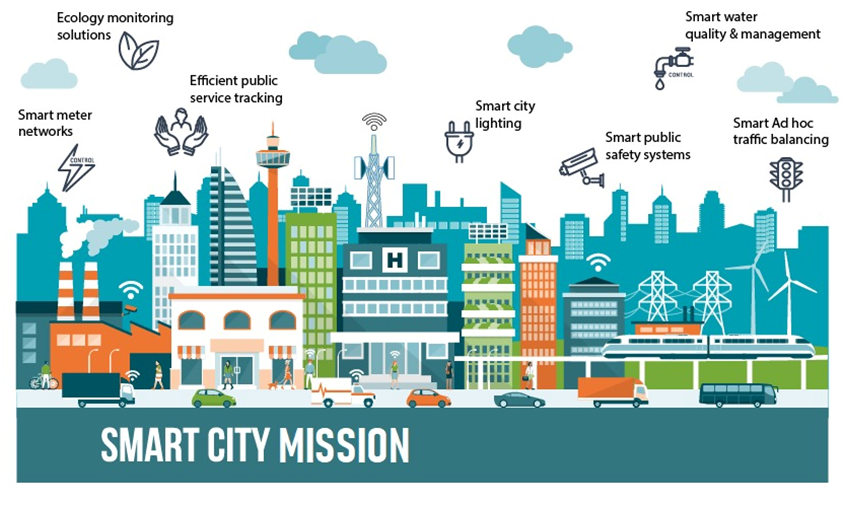
Using digital technologies (IoT, AI, cloud systems) to improve citywide infrastructure and services, such as:-
Smart traffic management systems
-
Intelligent street lighting
-
e-Governance and mobile apps for public services
-
Waste management and air quality monitoring
-
-
Citizen-Centric Approach:
Citizens participate in planning, suggesting projects, and giving feedback through digital platforms and consultations. -
Funding Mechanism:
-
₹500 crore (approx. $70 million) per city from the central government, matched by the state and local bodies.
-
Additional funds mobilized through PPPs and foreign investment.
-
3. The Progress So Far (2015–2025)
a. The Scale of Implementation
-
100 smart cities were selected in five rounds between 2016 and 2018.
-
These cities proposed over 5,000 projects with an estimated investment of ₹2.05 lakh crore (approx. $25 billion).
-
As of early 2025, more than 85% of projects have been completed or are under advanced stages of completion.
b. Key Achievements
1. Urban Infrastructure Upgrades
-
Smart roads and transport: Cities like Pune, Surat, and Indore have implemented integrated traffic control systems and smart parking.
-
Energy efficiency: LED streetlights in most cities have reduced power consumption by up to 40%.
-
24×7 water supply: Projects in cities like Nagpur and Ahmedabad have improved water access and monitoring through IoT sensors.
2. Smart Governance
-
More than 90 cities have operational Integrated Command and Control Centers (ICCCs).
These centers monitor traffic, waste, air quality, water supply, and emergency responses in real-time.
For example:-
Bhopal Smart City’s ICCC manages traffic lights, CCTV feeds, and public alerts from one platform.
-
Surat ICCC helped coordinate emergency management during the COVID-19 pandemic.
-
3. Waste and Sanitation Management
-
Cities like Indore and Mysuru have achieved near-zero waste-to-landfill status using automation and citizen participation.
-
Smart bins and GPS-based garbage collection are used for real-time waste tracking.
4. Green and Sustainable Initiatives
-
Rooftop solar systems installed in public buildings have significantly increased renewable energy adoption.
-
Green corridors and electric bus fleets are reducing urban air pollution.
-
Several cities now promote non-motorized transport (NMT) — cycling and walking tracks.
5. e-Governance and Citizen Services
-
Over 70 cities have launched mobile apps for complaints, tax payments, and service requests.
-
Online grievance systems have improved citizen satisfaction and transparency in administration.
4. Case Studies: Smart Cities That Stand Out
a. Pune
Pune has emerged as a model city with extensive public participation. Its Pune Connect App allows citizens to interact directly with officials.
-
Projects: Smart street lighting, river rejuvenation, and public Wi-Fi zones.
-
Impact: Reduced traffic congestion and better air quality.
b. Surat
Known for its business efficiency, Surat implemented one of the most effective ICCCs.
-
It integrates traffic, health, and environmental data on a single dashboard.
-
The system was vital in pandemic response and flood management.
c. Indore
Repeatedly ranked as India’s cleanest city, Indore’s waste segregation model is now adopted nationwide.
-
100% door-to-door waste collection.
-
Smart sensors track waste collection vehicles.
d. Bhubaneswar
Ranked first in the Smart Cities Challenge, Bhubaneswar has focused on child-friendly, inclusive design and urban mobility.
-
Integrated transit system linking buses and rickshaws.
-
Development of green zones and cycling tracks.
e. Varanasi
Combines heritage conservation with smart infrastructure.
-
Riverfront redevelopment.
-
Digital monitoring of sanitation near ghats and temples.
These examples show that technology combined with strong local governance can drive meaningful transformation.
5. Economic and Social Impact
a. Job Creation
The mission has generated employment through construction, IT, and maintenance of smart systems.
According to MoHUA, over 2.5 lakh direct jobs have been created, with additional indirect jobs in local businesses and startups.
b. Boost to Startups and Innovation
The focus on smart solutions has encouraged urban tech startups.
Examples:
-
Staqu – AI surveillance solutions for city safety.
-
Chakr Innovation – Air purification for traffic-heavy zones.
-
Smart Joules – Energy optimization in public buildings.
c. Enhanced Quality of Life
Improved transport, cleanliness, public safety, and access to utilities have contributed to a better urban living experience.
Surveys show rising satisfaction levels among residents of cities like Pune, Indore, and Surat.
6. Challenges Facing the Smart City Mission
Despite visible progress, the mission has faced numerous administrative, financial, and infrastructural challenges.
a. Funding and Financial Constraints
While each city was allotted ₹500 crore from the central government, urban transformation often requires far greater investment.
Many cities struggle to attract sufficient private investment or recover operational costs.
b. Implementation Delays
Land acquisition issues, slow tendering processes, and bureaucratic red tape have caused project delays in several cities.
As of 2025, some cities still have incomplete or stalled projects due to coordination gaps between multiple government agencies.
c. Technological and Data Challenges
-
Many cities face interoperability issues between legacy systems and new technologies.
-
Lack of data security frameworks increases concerns about privacy and surveillance.
-
Smaller cities lack skilled personnel to manage complex digital systems like ICCCs.
d. Urban Inequality and Inclusivity
While smart infrastructure benefits middle- and upper-income citizens, marginalized communities often remain excluded.
For example:
-
Slum redevelopment has lagged behind.
-
Affordable housing and digital literacy programs need more attention.
e. Environmental Concerns
Rapid construction without environmental safeguards risks green space loss and urban heat islands.
Only a few cities have integrated strong climate resilience measures into their smart plans.
f. Governance and Institutional Challenges
The mission’s execution relies on Special Purpose Vehicles (SPVs) — independent bodies set up for each city.
However, in some cases:
-
SPVs lack accountability to elected local governments.
-
Conflicts arise between state authorities and city corporations.
These issues highlight the need for holistic urban governance, not just technological upgrades.
7. The Role of Technology and Innovation
a. Internet of Things (IoT)
IoT sensors are central to smart cities — they collect real-time data on traffic, pollution, and energy use.
Example: Ahmedabad’s smart traffic lights adjust automatically based on vehicle density.
b. Artificial Intelligence (AI) and Data Analytics
AI is used for predictive maintenance of utilities, analyzing citizen feedback, and managing resources efficiently.
c. Geographic Information Systems (GIS)
GIS mapping helps cities in land use planning, flood management, and infrastructure monitoring.
d. Renewable Energy Integration
Smart grids and solar energy adoption are vital for sustainability.
Cities like Chandigarh and Jaipur have implemented large-scale solar rooftop projects.
e. Smart Mobility
E-mobility and integrated public transport are at the core of urban modernization.
Electric buses and shared transport apps reduce carbon footprints while improving connectivity.
8. Smart City Mission and India’s Broader Development Goals
The Smart City Mission aligns with India’s long-term national and global commitments:
-
Sustainable Development Goals (SDGs) – particularly SDG 11 (Sustainable Cities and Communities).
-
National Urban Transport Policy – improving mobility and reducing congestion.
-
Climate Action Goals – promoting renewable energy and green buildings.
-
Digital India Initiative – encouraging e-governance and digital services.
By integrating these agendas, the mission contributes directly to India’s goal of becoming a $5 trillion economy.
9. The Road Ahead: Future of Smart Cities in India
As India moves forward, the next phase of the Smart City Mission will emphasize scaling up successful models, ensuring inclusivity, and promoting climate resilience.
a. Focus Areas for 2025–2030:
-
Digital Twin Cities: Real-time virtual models of urban environments for better planning.
-
AI-driven Governance: Automated service delivery and citizen analytics.
-
Green Urbanization: Expansion of solar energy, EVs, and waste-to-energy plants.
-
Affordable Smart Housing: Integrating smart amenities into housing for all.
-
Inclusive Development: Bridging digital divides and ensuring equitable benefits.
b. Capacity Building
Training city officials and engineers to manage and analyze smart infrastructure will be essential.
c. Citizen Participation
Future smart cities must be “citizen-smart,” not just tech-smart.”
Engagement, feedback loops, and community ownership will sustain long-term success.
10. Conclusion: Toward a Smarter, More Inclusive India
A decade into the Smart City Mission, India has made remarkable strides in urban modernization, technology adoption, and sustainable planning. Cities like Pune, Surat, Indore, and Bhubaneswar demonstrate how innovation and citizen collaboration can transform the urban experience.
However, challenges—ranging from finance to inclusivity—persist. To realize the full potential of the Smart City Mission, India must adopt a balanced approach, where technology serves people, not the other way around.
The mission’s success lies not just in smart systems, but in smart citizens, transparent governance, and sustainable urban living.
As we move deeper into the digital decade, India’s Smart City Mission represents more than infrastructure—it’s a vision for the future of urban India: connected, clean, inclusive, and resilient.

