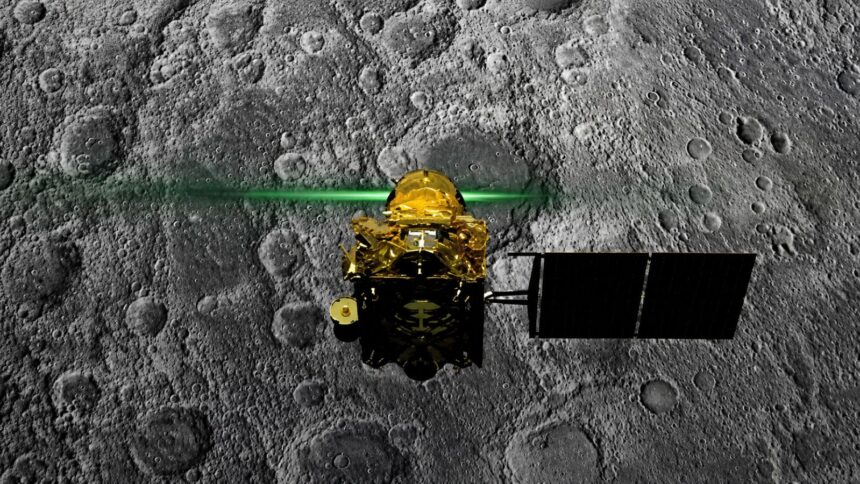
Data collected by has established a close chemical relationship between the soil found at Shiv Shakti Point, the landing site near the Moon’s South Pole, and a lunar meteorite that had hit Antarctica’s Allan Hills region of Victoria land about a million years ago.
A new study led by a team of researchers from the Physical Research Laboratory (PRL) noted that the iron and magnesium-rich and aluminum-deficient soil found at the came closest chemically to the lunar meteorite ALHA 81005 discovered in Antarctica in 1982.
Dwijesh Ray, lead author and PRL scientist, told The Indian Express: “The -3 landing site occupies a compositional space between traditional ferroan anorthosite and Mg-suite lithologies (names of different types of rocks), and closely resembles the lunar meteorite ALHA 81005.”
Both ferroan anorthosite and Mg-suite lithologies are typical lunar rock types composed of specific elements, like calcium and magnesium.
The lunar surface has suffered numerous micro-meteorite and meteorite hits in the past, as a result of which the regolith layers (the top layers) on its surface have a certain chemical composition. But the possibility of deeper lava and mineral layers mixing with the surface soil as a fallout of these events were not scientifically established yet.
The latest results have emerged from the data gathered by the Alpha Particle X-ray Spectrometer (APXS), a scientific probe onboard the Pragyaan rover on Chandrayaan-3, had landed on the Moon’s South Pole in August 2023. The APXS is designed to unravel the chemical composition of the soil at the Chandrayaan-3 landing site.
The PRL team, in a new publication in the journal Nature, described the soil at the landing site to be a mix composition of a number of chemicals.
The meteorite found on Antarctica is composed 25.8% of aluminum oxide and 13.7% iron and magnesium oxides. And this specific chemical composition is an almost exact match to the soil measured by Chandrayaan-3 on the Moon, the publication noted.
Moreover, the soil composition at Shiv Shakti Point was found not only distinct from the other mountainous regions of the Moon but its composition indicated contributions from deeper layers that are enriched in iron and magnesium-bearing minerals.
“One possible explanation is the influence of the nearby South Pole-Aitken (SPA) basin, one of the largest and deepest impact structures in the solar system. The basin-forming impact likely excavated materials from deeper layers of the Moon and redistributed them around the landing site. The elevated iron and magnesium concentrations observed by APXS are consistent with such a contribution from deeper layers,” Ray said.
In addition to ALHA 81005, the team also compared lunar meteorites found on Earth in northwest Africa, Libya and Oman and analysed their chemical composition. These sites were chosen as they have been known to possess high magnesium and iron concentrations with closer representation of the lunar farside crust.
The emerging results have not only confirmed the lunar magma ocean theory, but also proven with scientific evidence the chemical traces found within deep molten layers.
Importance of the findings
The results highlight the compositional diversity that exists within the lunar highlands and demonstrate that different impact histories can expose and redistribute distinct crustal materials across the Moon. For upcoming rover missions, such geochemical information could help prioritise locations that are likely to contain materials excavated from deeper layers, that could prove valuable in providing insights into early evolutionary histories of the Moon.